
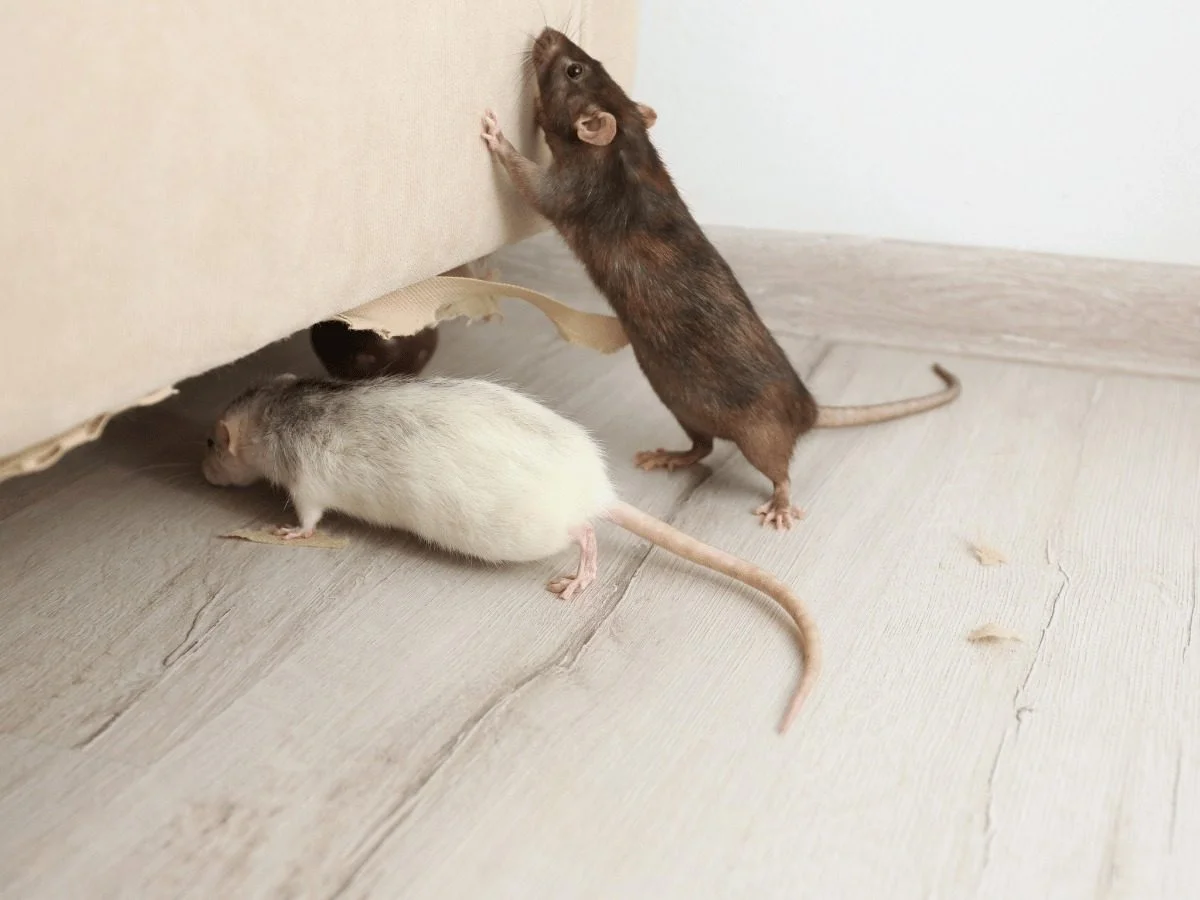
Why dry-sweeping is the wrong move
Rodent droppings and urine can carry disease organisms. When droppings dry out — which happens fast in Odessa's climate — they become brittle and crumble easily. Sweeping or running a household or shop vacuum over them grinds that material into a fine dust and pushes it airborne, where it can be inhaled.
The disease that drives the caution is hantavirus. It is carried primarily by the deer mouse, which is common on Odessa's rural edges — West Odessa, Gardendale, and the Ector County fringe — and in sheds, barns, and outbuildings. Hantavirus infections are uncommon, but the illness is serious, and the recognized route of exposure is breathing in aerosolized particles from droppings, urine, or nesting material. That is the entire reason the protocol is "wet it down, don't stir it up."
Rodent waste is also associated with other illnesses — salmonella among them — and rodent nests commonly harbor mites and fleas. None of that is a reason to panic. It is a reason to clean it correctly rather than casually.
The right way to handle rodent droppings
This is the approach public-health guidance describes, and the approach we follow:
- Ventilate first. Open the space up and let it air out before anyone works in it.
- Never dry-sweep, never dry-vacuum. No brooms, no household vacuum, no shop vac on dry droppings. This is the whole ballgame.
- Wet the material down. Saturate droppings, urine, and nesting with a disinfectant or a bleach solution and let it soak. Wetting keeps particles from going airborne when the material is picked up.
- Protection. Gloves at minimum, and for anything larger than a small isolated spot, proper respiratory protection — not a loose dust mask.
- Remove without stirring. Pick up the wetted material with paper towels or a damp method and bag it. Double-bag and dispose.
- Disinfect the surfaces the droppings sat on.
- Decontaminate what you can't discard. Where nesting material is involved, handle it wetted and bagged as well.
For a handful of droppings on a garage shelf, a careful homeowner can follow this safely. For an attic full of it, a crawl space, a wall void, an outbuilding, or anywhere deer mice are the likely species, the combination of airborne risk, confined space, and West Texas attic heat makes it a job worth handing off.
When to call us instead of DIY
- Large or widespread contamination — an attic, crawl space, shed, or garage with heavy accumulation
- Deer mouse territory — the outskirts and rural properties, where the hantavirus consideration is real
- Enclosed and poorly ventilated spaces — attics, crawl spaces, and wall voids where particles concentrate
- HVAC involvement — droppings inside ductwork or a return, which spreads contamination through the house every time the system runs
- You are immunocompromised, pregnant, or have a respiratory condition — the exposure math is different for you
- A rental or sale — when the cleanup needs to be documented for a landlord, tenant, or buyer
- It came with an infestation — droppings usually mean an active or recent population and an open entry point, which is the actual thing to fix
How our cleanup works
- Free assessment. We confirm the species, gauge how far the contamination spreads, and identify whether it is tied to an active infestation. Detail: rodent inspection.
- Containment. We protect the route out of the contaminated space so nothing gets tracked into clean living areas.
- Wet removal. Droppings, urine, and nesting are saturated with disinfectant and removed without aerosolizing — never dry-swept, never dry-vacuumed. HEPA filtration is used where fine-particle cleanup is required.
- Disinfection. Affected surfaces are disinfected once the waste is out, not before — wetting first, removing, then treating the surface is the order that keeps particles out of the air.
- Deodorizing and scent-trail elimination. Droppings and urine carry pheromone trails that draw new rodents to the same spot. Removing the trail is part of preventing a repeat.
- Contaminated materials handled — nesting, and where applicable soiled insulation, bagged and removed. Larger attic jobs: attic cleanup & decontamination.
- The real fix. Cleanup without sealing the entry points is temporary. We tell you where they are getting in and seal it: rodent exclusion & proofing.
Not sure if it is rats or mice?
The droppings tell you before anything else does:
- Mouse — rice-sized, roughly ⅛–¼ inch, pointed ends, scattered
- Rat — raisin-sized, roughly ½–¾ inch, blunt or pointed ends depending on species, often along a route
- Deer mouse vs. house mouse — similar in size; the animal and location matter more than the pellet here, which is exactly why identification is worth doing before cleanup on a rural property
Send a photo to (432) 319-8327 and we will tell you which one you are looking at, or compare them yourself: Rat vs. Mouse Droppings »
What it costs
The assessment is free, and it is the part that tells you which of the following you actually need.
Four things move the price after that: the size of the contaminated area — a shelf and a pantry corner is not an attic; the species, because deer mouse contamination on a rural property is handled with more care than a house mouse in a kitchen drawer; the access, meaning attic headroom, crawl space clearance and how far material has to be carried out; and whether insulation is involved, which is the single biggest swing because soiled insulation has to come out and be replaced rather than cleaned.
Cleanup is quoted as its own line, so if you are also having the building sealed you can see what each part costs instead of one blended number. Contact us for a free estimate.
Frequently asked questions
How do you safely clean up rodent droppings?
The safe method is to ventilate the space, avoid sweeping or vacuuming entirely, saturate the droppings and nesting with a disinfectant or bleach solution, let it soak, then remove the wetted material with gloves and respiratory protection and bag it — followed by disinfecting the surfaces. The core rule is never to dry-sweep or dry-vacuum, because that puts particles into the air.
Why shouldn't I vacuum mouse droppings?
Because a vacuum aerosolizes dried droppings into fine airborne particles, which is the recognized route of exposure for hantavirus and other rodent-borne illness. Wetting the droppings down first and removing them without stirring keeps those particles out of the air.
Are rat and mouse droppings dangerous?
They can be. Rodent droppings and urine are associated with several illnesses, and deer mice — present around Odessa's rural edges — are the main U.S. carrier of hantavirus. The risk from a small, carefully cleaned spot is low; the risk rises with volume, confined spaces, and dry-sweeping.
Can I just clean it up myself?
For a few droppings on a shelf, yes — ventilate, wet it down, glove up, wear proper respiratory protection, and never sweep or vacuum dry. For an attic, crawl space, outbuilding, or any heavy accumulation, especially in deer mouse territory, it is worth having done properly because of the airborne risk and the confined-space and heat factors in an Odessa summer.
Does bleach kill hantavirus on droppings?
A disinfectant or a diluted bleach solution is the standard recommendation for wetting and disinfecting rodent-contaminated areas. The protection comes from two things together: disinfecting the material and never aerosolizing it by sweeping or vacuuming.
How do I know if it's rats or mice from the droppings?
Mouse droppings are rice-sized with pointed ends and appear scattered; rat droppings are raisin-sized and often follow a travel route. Text a photo to (432) 319-8327 and we will identify it — we are reachable at any hour, so you are not waiting on office hours for an answer.
Will cleaning the droppings stop the rodents coming back?
Cleanup removes the health hazard and the scent trail, but it does not close the opening they used. Stopping the return requires sealing the entry points — which is why we pair cleanup with exclusion rather than selling it as a standalone fix. See rodent exclusion & proofing.
What if the droppings are in the ductwork?
Treat it as a priority, because the HVAC system circulates that contamination through the whole house every time it runs. Tell us what you found in the vents or the return at the assessment — we will look at it and tell you plainly what belongs to the cleanup and what belongs to a duct specialist, rather than leaving you to discover the split afterwards.
Can the cleanup be documented?
Ask us at the assessment and tell us what the documentation is for — a landlord, a tenant, a buyer, or a property file. It is worth raising before the work starts rather than after, because what gets recorded and photographed depends on the state of the space when we arrive. See Texas landlord-tenant rodent responsibility.
Main pages Rodent control in Odessa, TX·All rodent services·Exclusion & proofing·What it costs