
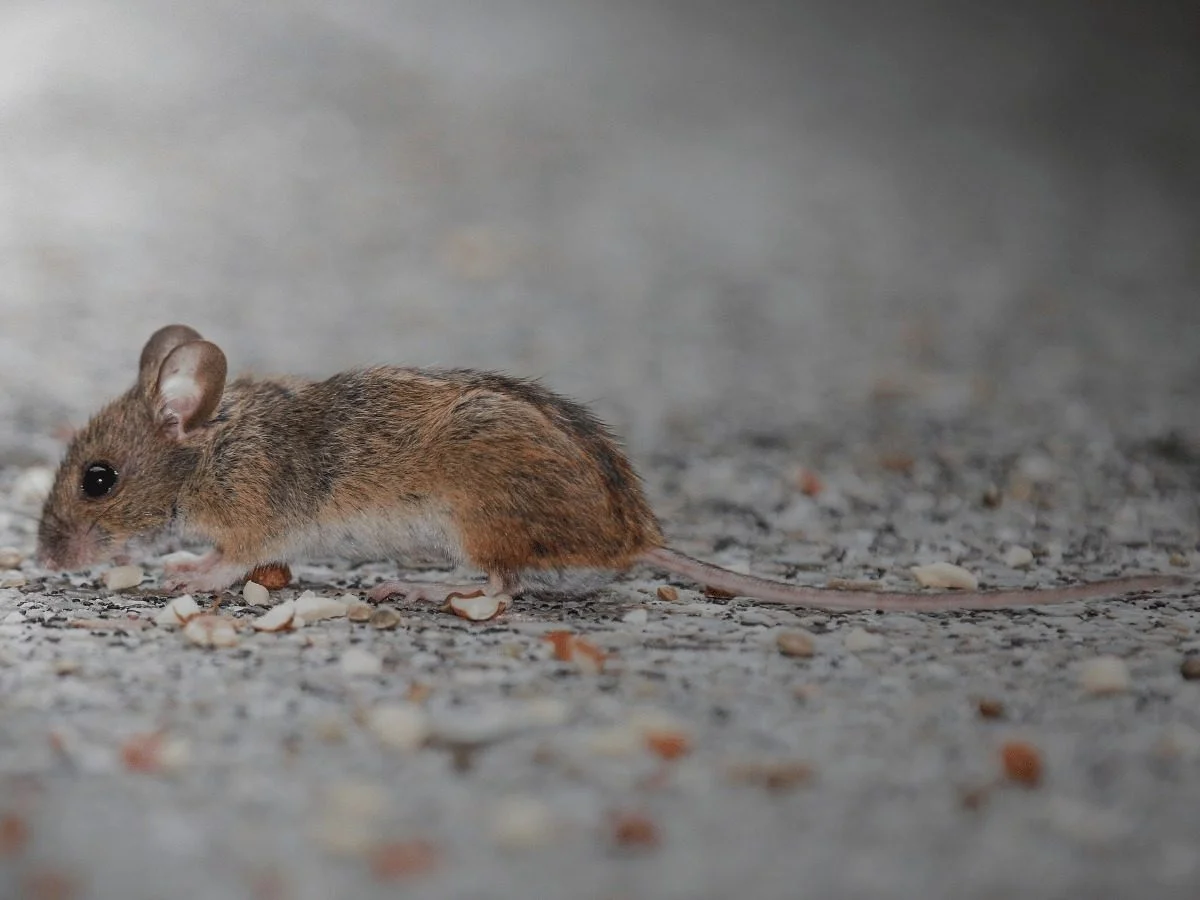
Why a couple of mice becomes a population
A house mouse reaches breeding age in about five to six weeks. Gestation runs roughly three weeks, litters typically run five or six young, and a female can produce litters repeatedly through the year. Those numbers compound in a way that feels unreasonable until you have seen it: a pair that gets into a warm Odessa garage in early fall can hand you a genuine infestation by midwinter.
They also need very little from you. A house mouse can survive on crumbs and often gets most of its moisture from food, so an immaculate kitchen is not the deterrent people hope it is. And they nest close to their food — usually within a short distance of it — which is why activity concentrates around pantries, under ranges, behind refrigerators, and in the cabinet under the sink.
The takeaway: with mice, speed matters more than with almost any other pest. Two weeks of "let's see if it gets worse" is measured in litters.
The mice we deal with around Odessa
House mouse (Mus musculus) — the one in your kitchen
Small, 2.5–4 inches of body with a tail about as long, dusty gray to light brown, uniform coloring. Droppings are rice-sized, roughly ⅛–¼ inch, with pointed ends, and they appear in scattered handfuls rather than tidy lines.
House mice are curious, not cautious — the opposite of rats. They investigate new objects, which makes them far easier to trap when the traps are placed correctly. Their limitation is not intelligence, it is volume: mice are territorial and range over a small area, so a few traps in one room does nothing about the mice living in the next wall over.
Deer mouse (Peromyscus maniculatus) — the one to be careful with
Distinctly bicolored: brown or grayish above, clean white belly, with a sharply two-toned tail. Larger eyes and ears than a house mouse.
Deer mice are far more common on Odessa's rural edges — West Odessa, Gardendale, and the Ector County fringe — plus sheds, barns, shops, and outbuildings rather than the middle of a subdivision. They are the primary carrier of hantavirus in the United States, which changes how their droppings and nesting material must be handled: never dry-swept and never dry-vacuumed. See rodent droppings cleanup.
Full ID guide: Common Odessa Rodents »
Signs of mice, including the ones people miss
- Droppings in enclosed spaces. Check the back of the silverware drawer, under the sink, behind the toaster, inside the pantry, along the top of cabinet toe-kicks, and in the garage on shelving.
- Light, fast skittering inside walls or above the ceiling, mostly after the house goes quiet.
- Small gnaw holes in packaging. Cereal boxes, chip bags, dog food, birdseed.
- Grease and smudge lines along baseboards where they run the same route repeatedly.
- Shredded nesting material — insulation, paper, cardboard, cotton, dryer lint — packed into a drawer, appliance cavity, or wall void.
- A stale, musky ammonia smell in a closed cabinet or closet.
- Chewed wiring in appliances, garages, and vehicles.
- Pets suddenly obsessed with one wall or appliance.
- Tracks in dust in the garage or attic.
If you find droppings and want a straight answer on rat vs. mouse before you call anyone, compare them here: Rat vs. Mouse Droppings »
The ¼-inch problem
A house mouse gets through a gap about ¼ inch wide — roughly the width of a dime. Young mice manage less.
That is the single most useful fact in this trade, because it explains the sentence we hear on nearly every call: "I looked, and there aren't any holes." There are. They just do not look like holes.
Where we find them on Odessa homes:
- The two bottom corners of the garage door, where the seal curls away
- Around the AC line set and refrigerant line penetration
- Under-sink plumbing penetrations, inside the cabinet
- Dryer vent with a broken flapper
- Weep holes in brick veneer
- Gaps at the slab edge where caliche settling has pulled things apart
- Threshold gaps under exterior doors, especially side and shop doors
- Where the water heater or furnace flue passes through
- Utility and low-voltage line penetrations
- Attic and gable vents with plastic or rusted screening
Sealing those is the actual fix, and it is our core service: rodent exclusion & proofing »
How we get mice out and keep them out
- Free inspection. We confirm house mouse vs. deer mouse (which changes the cleanup protocol), find the nesting areas and travel routes, and map every gap ¼ inch or larger. Detail: rodent inspection.
- High-density trapping. Mice are curious, so trapping works well — but only in volume and only in the right places. Traps go flush against walls, in runways, behind appliances, and inside the enclosed spaces mice actually use, not out in the open floor where it is convenient for us.
- Exclusion. Every mapped ¼-inch gap sealed with steel mesh, hardware cloth, and metal flashing. Foam and caulk alone do not hold — mice chew through both.
- Cleanup and sanitation. Droppings, urine, and nesting removed; contaminated insulation addressed; surfaces disinfected; scent trails eliminated so the location stops advertising itself. See attic cleanup and droppings cleanup.
- Follow-up verification. We return to confirm zero activity. Mice are small enough that one missed pocket restarts the problem, so this step is not optional.
- The entry points in writing. You get a list of what was closed and where, so the work is checkable later instead of taken on trust.
Call (432) 319-8327 or call (432) 319-8327.
Why the DIY mouse trap run usually fails
Not because you did it wrong — because mouse control has a few counterintuitive rules:
- Too few traps. Mice live in pockets across a building. Three traps in the kitchen do not reach the ten mice in the garage wall.
- Traps in the open. Mice run edges and stay under cover. A trap in the middle of the floor is a trap in a place a mouse avoids.
- Wrong orientation. The trigger end has to face the wall, in the runway.
- Too much on the trap. A pea-sized dab of peanut butter works better than a glob a mouse can eat around.
- Glue boards as the plan. They catch a few, miss most, and leave you dealing with a live animal.
- Ultrasonic repellers and peppermint oil. No mechanism to seal a gap and no mechanism to remove a resident population. They do not resolve an active infestation.
- The real one: nothing got sealed. You can trap forever. Until the ¼-inch gap is closed with steel, you are running a permanent catch-and-replace service on your own house.
Safe around kids and pets
Households with a toddler, a dog, a cat or backyard chickens usually want to know what is going to be placed in the house and where, before anybody starts. That is a fair question and the inspection is the right time to ask it — tell us the constraints and you will hear what the plan for your property is before any of it happens, not afterwards.
Trap placement is part of that conversation too. Mice run enclosed spaces, behind appliances and along the backs of cabinets, so that is where the work happens anyway — and in a house with a curious dog, agreeing on the specifics during the walk-through is worth the two minutes.
Worth reading before you decide:
- Poison-free rodent control — what the term actually means
- Pet-safe rodent control — what to ask about placement where a dog or cat has access
- Humane options — how the trapping choices differ
- Droppings are handled as a biohazard, wetted and removed, never dry-swept into the air
What mouse control costs in Odessa
The inspection is free, and there is no contract to sign to get one.
After that, three things move the number: the size of the home, how many entry points there are — a garage-door corner and a dryer vent is a different job from a house with a dozen open penetrations — and how far the problem has already spread, which decides whether cleanup and sanitation are part of the work or not.
Trapping, exclusion and cleanup are quoted as separate lines rather than one blended figure, so you can see what you are buying. Contact us for a free estimate and you get a firm number before anything starts.
Frequently asked questions
How do I get rid of mice in my Odessa home?
Getting rid of mice takes two steps together: trap out the active population with a high density of correctly placed snap traps, and seal every gap ¼ inch or larger with steel mesh and metal flashing. Trapping alone reduces the count temporarily; sealing is what makes it permanent.
How small a hole can a mouse fit through?
A house mouse can pass through a gap of about ¼ inch — roughly the width of a dime — and young mice fit through less. This is why homeowners routinely conclude there are no openings when there are a dozen.
If I saw one mouse, do I have more?
Almost certainly. Mice are not solitary once established, and by the time one is visible in daylight the population is usually larger than the space it was using. A single sighting also confirms at least one open entry point.
How long does mouse control take?
There is no single figure worth quoting: trapping runs until the activity stops, and how long that takes depends on how many separate pockets of mice there are and how large the building is. The exclusion work is the shorter half of the job. Either way, we confirm zero activity — not reduced activity — before closing it out.
Are mouse droppings dangerous?
Rodent droppings and urine can carry disease organisms, and deer mice in particular are the main hantavirus carrier in the U.S. Contaminated material should be wetted with disinfectant and removed with proper protection — never dry-swept or dry-vacuumed, because that puts particles into the air you are breathing.
Do mice go away in the summer?
No, they relocate. Odessa's extreme summer heat pushes mice toward cool, shaded, moist spaces — garages, AC chases, and wall voids — so activity often shifts rather than stops. Cold fronts then push them further inside. Detail: Odessa Rodent Seasonal Calendar.
Does peppermint oil keep mice away?
Not from an active infestation. Strong scents may briefly discourage a mouse from one spot, but they do not close the opening it entered through and do not remove the mice already nesting inside. Sealing is the only approach that holds.
What is the difference between a house mouse and a deer mouse?
A house mouse is uniformly gray-brown with a same-colored tail and lives mostly indoors in developed areas. A deer mouse is distinctly bicolored — brown above, white belly, sharply two-toned tail — is more common on Odessa's rural edges and in outbuildings, and is the primary hantavirus carrier, so its droppings require careful handling.
Why do I have mice if my house is clean?
Mice are looking for shelter and warmth, not mess. A clean home with a ¼-inch gap at the garage door corner is more attractive to a mouse than a cluttered one that is sealed tight. Cleanliness reduces food supply; it does not close entry points.
Do I have to sign a contract?
No. We do not require a recurring agreement to help you. We remove the mice, seal the building, tell you in writing what was closed, and you call us again only if you want to.
Should I use glue traps?
We do not recommend them as a control method. They catch a fraction of a population, leave a live animal to deal with, and pose a risk to pets and non-target wildlife. Correctly placed snap traps plus sealing is faster and more complete.
Main pages Rodent control in Odessa, TX·All rodent services·Exclusion & proofing·What it costs