
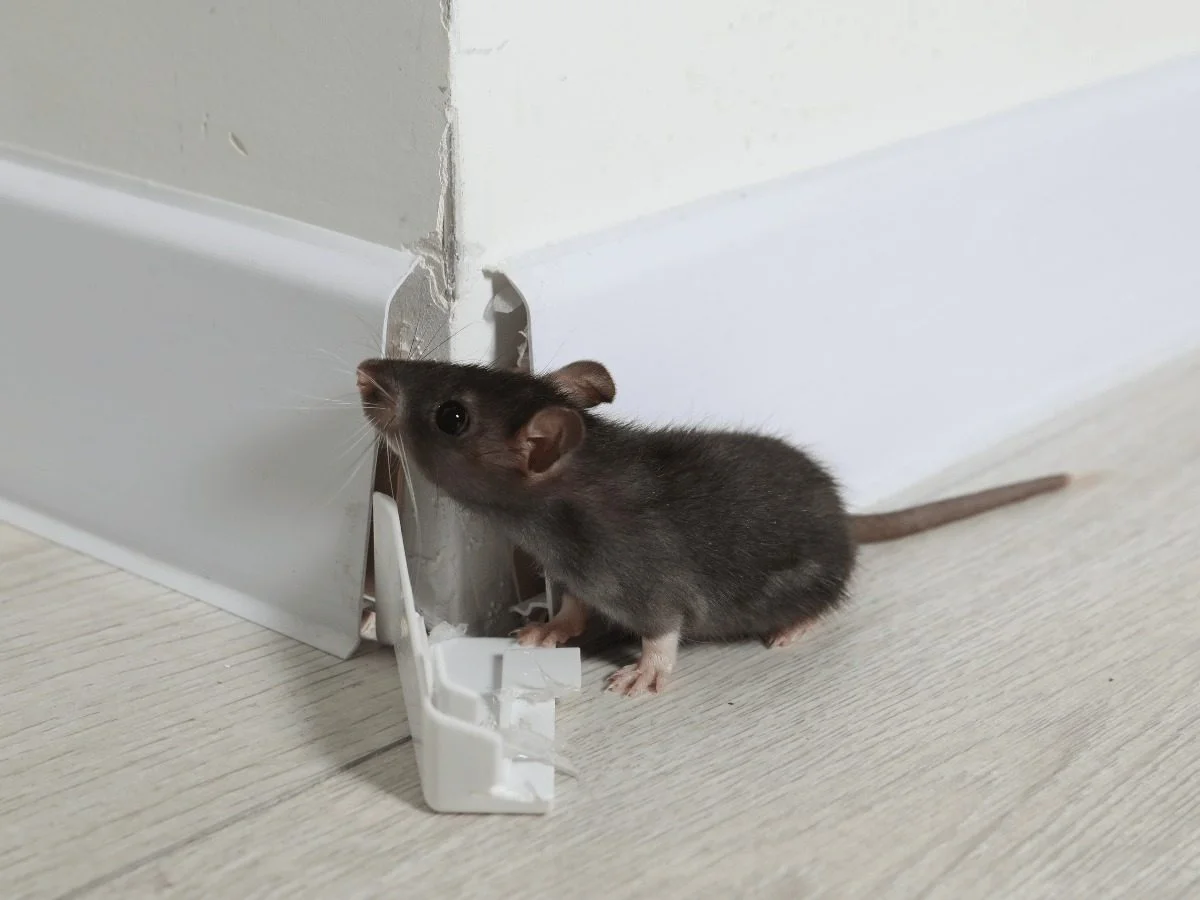
First, the numbers that matter
| Animal | Gap it needs | Real-world comparison |
|---|---|---|
| House mouse | About ¼ inch | The width of a dime |
| Young rat | About ⅜ inch | |
| Adult rat | About ½ inch | The width of a quarter |
Two things people get wrong about this:
- *A rodent doesn't need a hole it fits through — it needs a hole it can start on.* Rodents gnaw. A ¼-inch crack in mortar or a small gap in wood siding becomes a ¾-inch hole in a few nights. The gap you're looking for may be smaller than the animal.
- Mice can flatten. A mouse works through openings that look impossible, because its skeleton is more compressible than you'd expect. If you're squinting at a gap thinking "surely not" — assume yes.
The practical test: if you can slide a pencil into a gap, a mouse can use it.
Ground level (0–3 feet) — where mice and Norway rats come in
This is the zone that matters most for house mice and Norway rats.
1. Garage door bottom corners — the #1 entry in Odessa
The bottom seal presses flat mid-span but often lifts at the two bottom corners where it meets the vertical jamb, leaving a small triangular gap. Close the door, put the outside light on, and look at both corners from inside. Daylight means entry. Full detail: rats & mice in the garage »
2. Under the garage door, mid-span
A hardened, cracked, or worn seal — West Texas sun destroys rubber — or a low spot in the slab from caliche soil movement. A door that sealed perfectly five years ago often doesn't now.
3. The slab edge
Most Odessa homes are slab-on-grade, and the joint where the slab meets the wall assembly is a genuine gap in a lot of houses — particularly at cracks, at corners, and where soil movement has separated things. Look where the brick or siding meets the concrete.
4. Weep holes in brick veneer
The small vertical gaps in the mortar joints of the bottom brick course. They're supposed to be there — they drain and ventilate the wall cavity, so you cannot simply plug them. They're also a direct opening into the cavity, and from the cavity a rodent can travel up inside the wall to the attic. The correct fix is a weep hole cover or stainless mesh insert that blocks rodents while preserving drainage and airflow — not caulk, not foam, not mortar.
5. Exterior door thresholds
Front door, back door, garage man door, patio door. Worn sweeps, gaps at the bottom corners, and thresholds that have separated from a shifting slab.
6. Utility penetrations
Where anything enters the building at low level: water supply, gas line, electrical conduit, irrigation lines, low-voltage and cable, and hose bibs. These are routinely unsealed, or sealed once with expanding foam that a rodent has since chewed.
7. Exterior outlets, light fixtures, and boxes
The gap around the box, and often a direct opening into the wall cavity behind it.
8. Dryer vent
A missing, broken, or stuck exterior flap. Common, easy to check, easy to fix.
9. Crawl space vents and access hatches
Only if your home has a crawl space — most Odessa homes don't, since slab-on-grade dominates here. If yours does, the vents and the hatch are primary entries. Crawl space rodent control »
10. Burrows along the foundation
Not a hole in the building — a hole in the ground. A smooth 2–4 inch opening in the soil against the foundation, with a fan of excavated dirt, means Norway rats, and they're working their way to a gap at the slab. Norway rats »
11. Pet doors
Straightforward, and worth saying out loud.
Wall level (3–10 feet) — the transit zone
Rodents rarely enter here, but this is how they get from ground level to the attic.
12. The AC line set penetration
Where the refrigerant lines and condensate line enter the wall from the condenser. This is one of the most consistently unsealed openings on an Odessa house — often finished with a sleeve, a bit of foam, or nothing. It leads straight into the wall cavity and up. AC unit rodent control »
13. Plumbing and vent penetrations through the wall
Anywhere a pipe passes through the exterior wall.
14. Gaps where two wall materials meet
Brick to siding, stucco to trim, stone veneer edges, and around window and door trim where caulk has failed.
15. Cracked or missing mortar
Anywhere a rodent can start gnawing on a mortar joint that's already deteriorating.
16. Behind or through wall vents
Bath fan and range hood exterior terminations with damaged or missing damper flaps.
17. Inside the wall cavity itself
Not an entry from outside, but worth understanding: once a rodent is in the cavity — via a weep hole, the slab edge, or the line-set penetration — the wall cavity is a vertical highway connecting the ground to the attic and to every interior opening. This is why "I only see them upstairs but they must come from outside" makes sense.
Roof level (10 feet and up) — where roof rats come in
This is the zone for roof rats, and it's where most Odessa attic problems start.
18. Fascia and soffit gaps at the roofline
The joint where the roof deck meets the wall — especially at corners, at the ends of runs, and where two rooflines intersect. This is the number one attic entry point we find.
19. Soffit vents
Never properly screened, screening torn, or the vent panel loose or missing.
20. Ridge vents, turbine vents, and gable vents
Damaged, corroded, or missing screening. Turbine vents are frequent offenders.
21. Roof penetrations
Plumbing vent stacks, exhaust flues, and any pipe through the roof — the boot or flashing degrades in West Texas sun, cracks, and pulls away from the pipe.
22. Where two rooflines intersect
Valleys, dormers, and the point where a lower roof meets a taller wall. Complex rooflines have more of these, and each one is a candidate.
23. Chimney chases and flue penetrations
24. Damaged or lifted shingles and decking, and gable-end trim
25. Where brick veneer meets the roofline
A clear path from the wall cavity into the attic.
And how they reach the roof
Roof rats don't fly. Cut off the bridge and the entire roof-level list becomes much harder to use.
- Tree limbs touching or overhanging the roof. The most common bridge. A rat will jump a surprising gap — limbs need real clearance, not "close."
- Mesquite and shrubs growing against the wall.
- Utility lines and cable runs. Rats travel power and cable lines without hesitating.
- Fences that meet the house, especially block or wood fences running to a wall.
- The AC condenser, downspouts, trellises, and stacked material against the wall — anything climbable.
- Rough brick, stone, and stucco. Rats climb textured vertical surfaces better than people expect. Sometimes there is no bridge; there's just a wall.
Interior openings — how they get from inside the walls into your rooms
Once a rodent is in the wall cavity or attic, these are the doors into your living space. They matter because sealing the outside without addressing these leaves the animals already inside with full access.
- Under the kitchen sink — the gaps around the drain and supply lines. Very often finger-width. Rodents in the kitchen »
- Behind and under the dishwasher, refrigerator, and stove — plumbing and electrical penetrations
- The toe kick under the base cabinets — an enclosed run the length of the kitchen
- Under bathroom vanities — around the drain and supply lines
- Behind the washer and dryer — the drain box and water line penetrations
- Around the water heater — the platform, the flue, and combustion air openings
- Gaps at the top plate of walls, in the attic — where the wall cavity opens into the attic
- Around HVAC boots and register openings
- Recessed light housings and ceiling fan boxes
- The attic hatch or scuttle, if it doesn't seal
- Bath fan housings
- Behind loose baseboards and around plumbing chases
Why Odessa houses in particular
Three local conditions do most of the work here.
Caliche soil movement. The soil under Odessa moves — it heaves and it settles. That opens hairline gaps at slab edges, thresholds, mortar joints, and utility penetrations, and it creates low spots under garage doors. This is why a house that never had rodents suddenly does. Nothing was neglected; the ground moved.
Extreme UV and heat. 100°F-plus summers destroy rubber seals, caulk, roof boots, and weatherstripping faster than in most climates. Sealing materials here have a shorter service life, and a house that was properly sealed five years ago may not be now.
The urban edge. Odessa transitions to open range, mesquite, and cactus quickly. Properties in West Odessa, Gardendale, and anywhere backing onto open land carry constant pressure from the surrounding landscape — including native pack rats and cotton rats that live out there year-round.
Add to that: oilfield structures and equipment across the Permian Basin, and vacant-lot mowing and land clearing that periodically push whole populations toward the nearest building.
What actually seals an opening
Short version, because the pillar page covers the work itself.
Works: galvanized steel mesh and hardware cloth, sheet metal and metal flashing, mortar and concrete patch, copper mesh in irregular gaps, purpose-made metal weep hole covers, and metal-reinforced door sweeps and thresholds.
Doesn't work as a barrier: expanding foam — rodents chew straight through it, and it's the most common thing we find failed. Steel wool — it rusts and it pulls out. Caulk and silicone alone. Plastic or vinyl screening. Duct tape. Wood filler.
Foam and caulk have a legitimate role as an air and moisture seal behind or around metal — just never as the thing keeping the rodent out.
And one thing you must not do: don't plug weep holes solid. They're drainage for the wall cavity. Use a proper cover that blocks rodents and lets water and air through.
The full method: rodent exclusion & proofing »
Frequently asked questions
How small a hole can a mouse get through?
About a quarter inch — roughly the width of a dime. A rat needs about half an inch, and a young rat about three-eighths. More importantly, rodents gnaw, so they don't need a hole they already fit through; a small crack in mortar or a gap in wood becomes a usable opening within a few nights. If you can slide a pencil into a gap, treat it as an entry point.
How are mice getting into my house?
In Odessa homes the most common routes are the bottom corners of the garage door, a worn seal or heaved slab under the garage door, gaps at the slab edge, open weep holes in brick veneer, exterior door thresholds, unsealed utility penetrations including hose bibs and conduit, the AC line-set entry into the wall, and the dryer vent. Mice can also flatten to work through openings that look far too small to use.
Where do rats get into a house?
It depends which rat. Roof rats enter at height — gaps at the fascia and soffit, unscreened ridge, turbine, gable, and soffit vents, degraded roof boots and flashing, and where two rooflines intersect — reaching the roof via tree limbs, utility lines, or by climbing textured walls. Norway rats enter low, at the slab edge, garage door, and thresholds, often after burrowing along the foundation.
Should I seal the weep holes in my brick?
Not solid, no. Weep holes are intentional — they drain and ventilate the wall cavity, and blocking them with caulk, foam, or mortar can cause moisture problems inside the wall. The correct approach is a purpose-made weep hole cover or stainless mesh insert that stops rodents while allowing water and air through. They are a genuine rodent entry, so they do need addressing — just not by plugging them.
Does expanding foam keep mice out?
No. Rodents chew straight through expanding foam, and failed foam is the most common thing we find where someone has already tried to seal a house. Steel wool is also inadequate as a permanent barrier because it rusts and can be pulled out. Effective exclusion uses rigid materials — galvanized steel mesh, hardware cloth, sheet metal, and mortar — with foam used only as a secondary air seal behind the metal.
How do rats get on my roof?
Most often by a bridge: tree limbs touching or overhanging the roof, shrubs and mesquite growing against the wall, utility and cable lines, or a fence running into the house. They'll also climb the AC condenser, downspouts, trellises, and stacked material against a wall. Rats also climb rough brick, stone, and stucco better than most people expect, so sometimes there's no bridge at all — just a textured wall.
Why do I suddenly have rodents when I never did before?
In Odessa the usual explanation is that the building changed without anyone noticing. Caliche soil movement heaves and settles the slab, opening gaps at slab edges, thresholds, and mortar joints and creating low spots under garage doors, and intense UV and heat degrade rubber seals, caulk, roof boots, and weatherstripping faster than in milder climates. Outside triggers matter too — a cold front, or a neighboring lot being mowed or cleared.
Do rodents come up through the plumbing or the drains?
It's uncommon but not impossible, and it's associated with Norway rats where sewer or drain lines are broken or improperly capped rather than with intact plumbing. Far more often, what looks like a plumbing entry is actually the gap around the pipe — the unsealed penetration where the drain or supply line passes through a cabinet floor, wall, or slab. Those gaps are frequently finger-width and are a genuine primary route.
How many entry points does a typical house have?
More than one, essentially always — which is why sealing the single hole you found rarely resolves the problem. A rodent uses the easiest opening available, so closing it just promotes the next-easiest, and that's the pattern behind "we sealed it and they came back." A proper inspection works the whole envelope from ground level to roofline rather than stopping at the first gap.
Can I find the entry points myself?
You can find some, and it's worth doing — the garage door corners, the dryer vent, the thresholds, and open weep holes are all visible from the ground with a flashlight. What homeowners typically miss are the roofline gaps at fascia and soffit corners, the condition of vent screening, degraded roof boots, and the interior openings around plumbing and behind appliances. Those need someone on the roof and in the attic.
Main pages Rodent control in Odessa, TX·All rodent services