
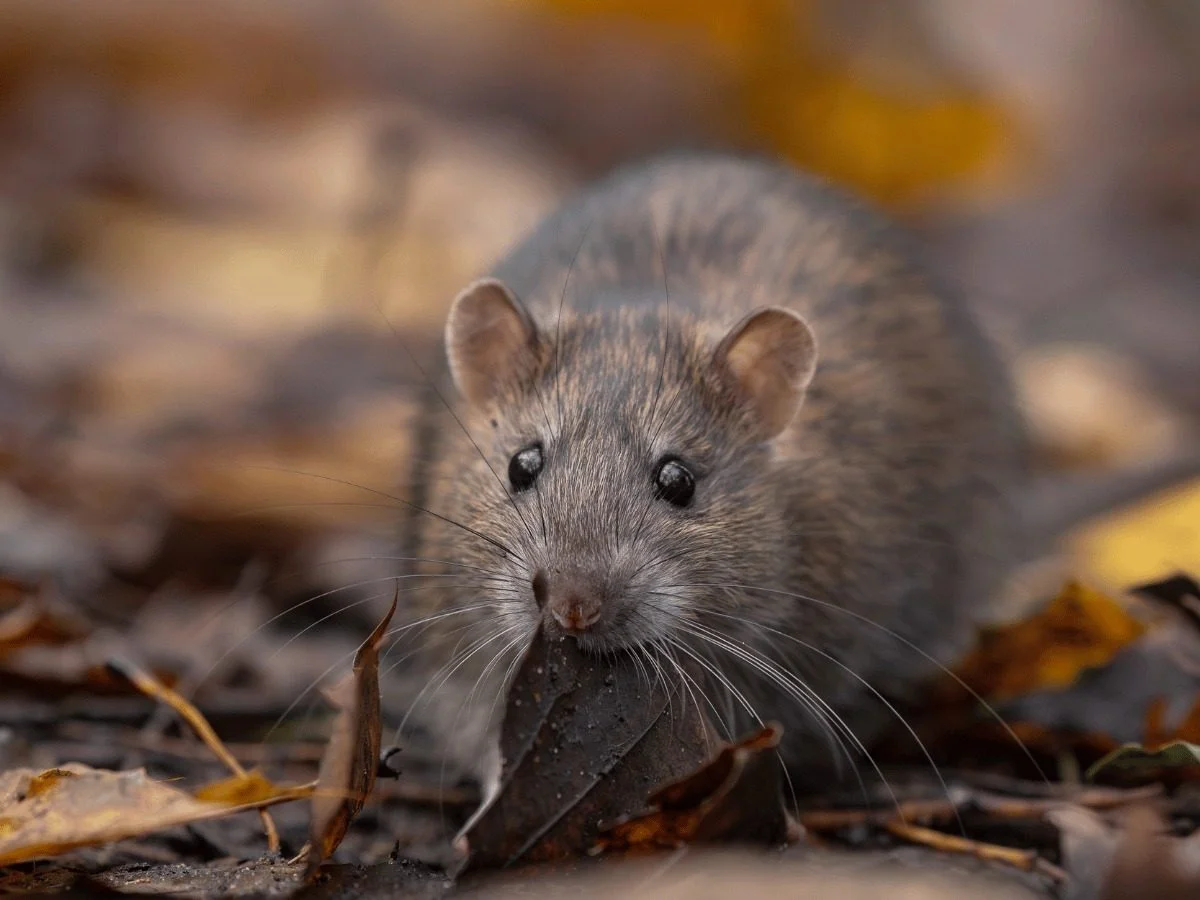
Rats or mice? Start here
Getting the species wrong sends you looking in the wrong half of the building. Here is how they separate:
| Rat | Mouse | |
|---|---|---|
| Droppings | Raisin-sized, ~½–¾ inch | Rice-sized, ~⅛–¼ inch |
| Sound | Heavy, deliberate thumps and drags | Light, quick skittering |
| Body | 7–10 in. plus tail | 2.5–4 in. plus tail |
| Gap needed | About ½ inch (a quarter) | About ¼ inch (a dime) |
| Temperament | Cautious of new objects | Curious, investigates anything |
| Gnaw damage | Wood, plastic, wiring, drywall, block | Smaller, finer chew marks |
| Food theft | Drags food off to a cache | Nibbles in place, near the source |
Full identification help: Rat vs. Mouse Droppings » · Common Odessa Rodents »
Not sure? Send us a photo of the droppings and we will tell you which one you have.
The two rats we deal with around Odessa
Roof rat (Rattus rattus) — the climber
Slender body, tail longer than the body, pointed nose, large ears, large eyes. Droppings are smaller than a Norway rat's, with pointed ends.
Roof rats live up. They travel fence lines, tree limbs, utility lines, and block walls, then enter high — through roofline gaps, fascia separation, gable and attic vents, and where the AC line set enters the wall. Their nests go in attics, soffits, garage ceilings, and palm or ornamental trees.
If the noise is above your ceiling, this is usually the animal — and work done at ground level never touches a population living at roof height, which is exactly why so many attic rat problems survive a treatment.
Norway rat (Rattus norvegicus) — the burrower
Heavier and thicker, tail shorter than the body, blunt nose, small ears, small eyes. Droppings are larger with blunt ends.
Norway rats live down. They dig burrows along foundations, under slabs and patios, beneath sheds and woodpiles, and around dumpsters and drain lines. They enter at ground level: foundation cracks, garage door corners, gaps under thresholds, utility penetrations, and compromised sewer or drain lines.
If you are seeing burrow holes about 2–4 inches across near the foundation, or activity in the garage and lower walls, this is usually the animal.
And the local wildcard: the pack rat
The white-throated woodrat, or pack rat, is a West Texas problem the rest of the country barely thinks about. It nests in mesquite, cactus, sheds, and — infamously — engine bays and AC condenser units, and it strips wiring for nest material. Because it costs Permian Basin residents real money in vehicle repairs, we treat it as its own service: Rodent Vehicle & Wiring Damage » · AC Unit Rodent Control »
Signs you have rats, in the order people usually notice them
- Sounds after dark. Rats are mostly nocturnal. Thumping, dragging, and gnawing overhead or inside a wall, starting around dusk.
- Droppings in a consistent line. Rats follow the same routes nightly. Droppings collect along walls, on top of beams, behind appliances, and in cabinet corners.
- Gnaw marks. Fresh chewing looks pale and rough. Rats chew constantly because their incisors never stop growing — through wood trim, plastic pipe, insulation, drywall, and wiring.
- Rub marks and runways. Rats travel edges, and body oil plus dust leaves dark smudge lines along baseboards, beams, and pipe runs.
- Burrow holes. Norway rats leave clean, smooth-edged holes near foundations, under slabs, or beside sheds.
- Tracks in dust. Easy to spot in an Odessa attic or garage — footprints and tail drags in the dust layer.
- Nests. Shredded insulation, paper, cardboard, and fabric packed into a void.
- A pet fixated on one spot. Dogs and cats hear them long before you do.
- The smell. Heavy ammonia from urine, or the unmistakable odor of something dead in a wall. If it is the latter: Dead Rodent Removal »
Why rats are worse than a nuisance
- Fire risk. Chewed wiring insulation exposes live conductors. This is the damage nobody sees until something fails.
- Structural and system damage. Gnawed plumbing lines, ductwork, ruined insulation, chewed drywall and framing.
- Contamination. Rats foul food, surfaces, and stored goods with droppings and urine. Rats worldwide are associated with diseases including leptospirosis, salmonellosis, and rat-bite fever.
- Secondary pests. Rodent nests bring mites, fleas, and — after a rodent dies — blow flies and carrion beetles.
- Insulation loss. Compressed, urine-soaked insulation loses R-value, and in a West Texas summer that shows up on your electric bill.
- They multiply fast. Rat gestation runs roughly three weeks and females can produce multiple litters a year, with young reaching breeding age in a few months. A pair in spring is a serious problem by fall.
How we get rats out
Rats are neophobic — genuinely suspicious of anything new in their environment. Drop a shiny trap in a runway and a smart rat will simply route around it for a week. This is where most DIY attempts stall out, and it is why technique matters more with rats than with mice.
- Free inspection and species confirmation. We identify roof rat vs. Norway rat from droppings, rub marks, runways, and travel height, because it determines whether we work the roofline or the foundation. Full detail: rodent inspection.
- Entry-point mapping. Every gap ½ inch or larger, inside and out — roofline, vents, plumbing and AC penetrations, garage door corners, foundation cracks, and any outbuildings.
- Trapping done properly. Heavy-duty snap traps placed in established runways, oriented correctly against the wall, and set in volume — rats learn, so a handful of traps invites trap-shyness. Where a rat is wary, we pre-set unarmed traps so the object becomes familiar before it becomes a trap.
- Exclusion — the part that ends it. We seal every mapped opening with galvanized steel mesh, hardware cloth, and metal flashing. Not spray foam, which a rat removes in a night. This is our core service: rodent exclusion & proofing.
- Cleanup and scent-trail removal. Rat urine and droppings leave pheromone trails that advertise the route to the next rat. Removing the contamination removes the invitation. See attic cleanup and droppings cleanup.
- Follow-up verification. We return and confirm zero activity rather than reduced activity, and the points we sealed are re-checked at the same time. You also get the closed entry points listed in writing, so the work is checkable later instead of taken on trust.
Why trapping is the core of a rat job
Trapping physically removes the animal, and with rats that matters more than it does with mice. A rat that dies inside a wall cavity, above a ceiling or in a duct chase is a second job — a weeks-long odor problem, a fly hatch, and drywall to open to reach it. See dead rodent removal for what that involves.
It also gives you a count. Traps tell you how many came out and when the activity stopped, which is the only honest way to know a population is actually cleared rather than temporarily quiet.
Related reading if the methods matter to you: poison-free rodent control · pet-safe rodent control
What rat control costs in Odessa
The inspection is free, including the roof and attic look, and there is no contract to sign.
Four things move the number after that: the species — a roof rat job is roofline work and a Norway rat job is foundation and burrow work, and they are not the same day; how long the problem has run, which decides how much contamination and gnaw damage there is; the size of the home; and the access, meaning roof pitch, attic headroom and how many outbuildings are in scope.
Trapping, exclusion, attic cleanup and dead-rodent removal are quoted as separate lines rather than one blended figure, because a rat job can need one of them or all four. Contact us for a free estimate and you get a firm number before anything starts.
Frequently asked questions
How do I get rid of rats in Odessa, TX?
Getting rid of rats takes three things in order: identify whether you have roof rats (which enter high, at the roofline) or Norway rats (which enter low, at the foundation), trap out the active population, then seal every gap ½ inch or larger with steel mesh and flashing. Skipping the sealing step is why rat problems come back.
What is the difference between a roof rat and a Norway rat?
A roof rat is slender with a tail longer than its body and it enters buildings high — rooflines, attic vents, and tree limbs. A Norway rat is heavier with a tail shorter than its body and it burrows, entering at ground level through foundation cracks and garage gaps. The species determines where treatment has to happen.
How long does it take to get rid of rats?
Longer than a mouse job, because rats are cautious and a population takes several nights of trapping to work through rather than one. There is no fixed figure worth quoting — it depends on the size of the population and how much of the building they are using. The exclusion work is the shorter half. We verify zero activity at follow-up before calling it finished.
Why do I have rats when my house is clean?
Rats are not attracted by mess — they are attracted by shelter, water, and an opening. In Odessa, that means heat driving them to shaded and cool spaces, cold fronts driving them indoors, and shifting caliche soil opening foundation gaps. A spotless home with a ½-inch gap at the garage door is still an invitation.
Do rats in the attic mean I need new insulation?
Not always. It depends on how long they were there and how much of the insulation is soiled and compressed. We assess it during the inspection and tell you honestly — partial removal is often enough. See attic cleanup & decontamination.
Will rats leave on their own?
No. Once rats have shelter, water, and a food source, they stay and breed. Waiting only adds gnaw damage, contamination, and more animals to remove later.
Why are rats harder to trap than mice?
Because rats are neophobic — genuinely suspicious of anything new in their environment. A mouse investigates a new object; a rat routes around it for days. That is why rat trapping depends on placement in established runways, correct orientation against the wall, volume rather than a handful of traps, and sometimes leaving traps unarmed at first so the object becomes ordinary before it becomes a trap.
Can one rat mean an infestation?
Usually, yes. Rats are social and live in groups, so a single visible rat generally indicates more that you have not seen — plus at least one entry point that is still open.
Are rat droppings dangerous to clean up?
Rodent droppings and urine can carry disease organisms, and dry sweeping or vacuuming aerosolizes the particles you least want to breathe. Rodent-contaminated areas should be wetted with a disinfectant first and cleaned with proper protection, never dry-swept. See rodent droppings cleanup.
What attracts rats to a West Texas yard?
Water sources (drips, pet bowls, irrigation leaks), pet food left out, bird seed, fruit trees, dense shrubs and mesquite, woodpiles and clutter against the house, unsecured trash, and tree limbs or fence lines that touch the roof. Cutting those back removes the staging area rats use before they find a way in.
Do you handle rats in sheds, shops, and metal buildings?
Yes. Detached shops, barns, and metal buildings are everywhere around Odessa and the oil patch, and they are usually where an infestation starts before it reaches the house. See commercial rodent control.
Main pages Rodent control in Odessa, TX·All rodent services·Exclusion & proofing·What it costs