
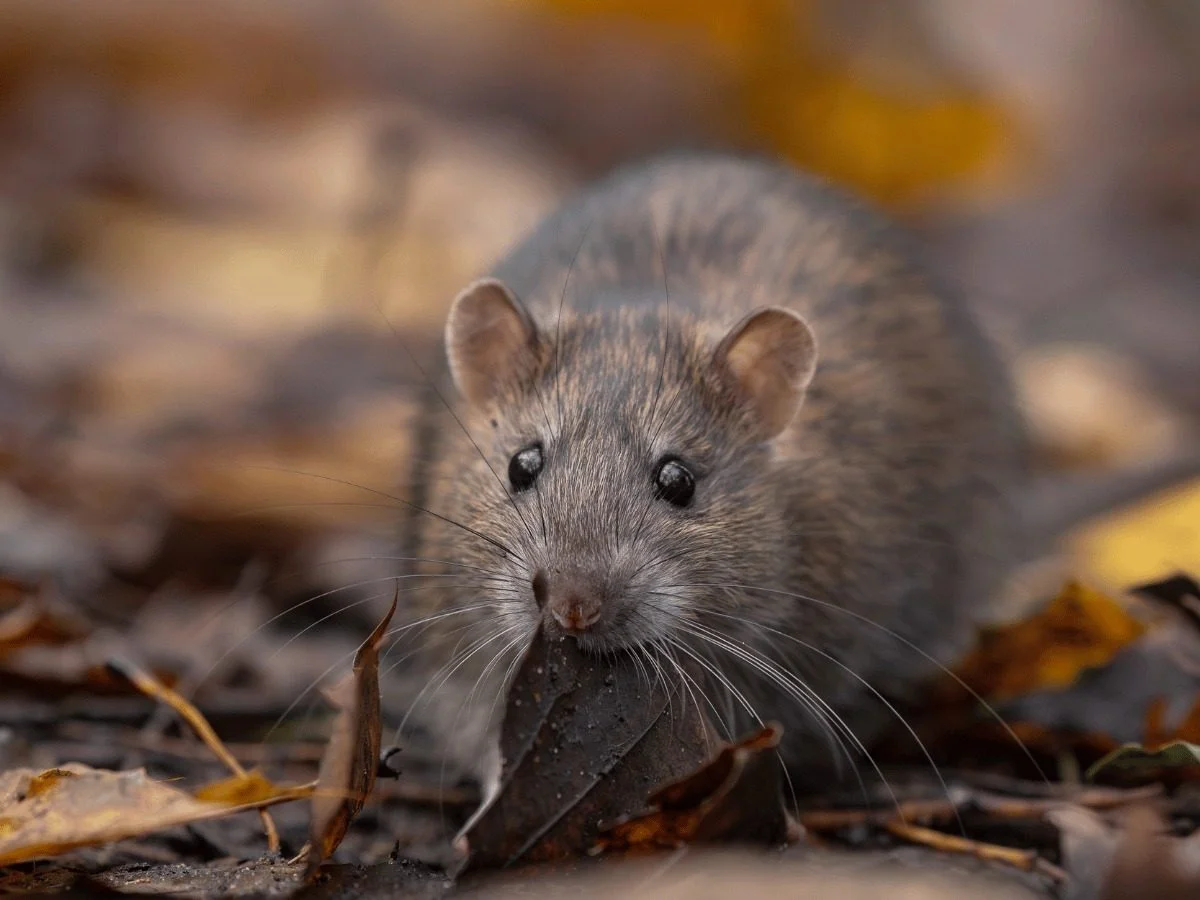
How to identify a Norway rat
| Feature | Norway rat |
|---|---|
| Also called | Brown rat, sewer rat, common rat |
| Body length | 7–10 in (plus tail) |
| Tail | Shorter than the body — the key field mark |
| Muzzle | Blunt |
| Ears | Small, close to the head |
| Eyes | Small |
| Build | Heavy, thick, robust |
| Fur | Coarse, brown to grayish-brown, paler belly |
| Droppings | ~¾ inch, blunt / capsule-shaped ends |
| Gap needed to enter | About ½ inch |
The tail test
Lay the tail back along the body. If it falls short of the shoulders, it is a Norway rat. If it reaches past the nose, it is a roof rat. Combine that with body build — a Norway rat is noticeably heavier and thicker — and the muzzle, which is blunt rather than pointed.
The burrow is a giveaway on its own
Norway rats dig, and roof rats do not. A smooth-walled hole about 2–4 inches across near a foundation, slab, or shed is a Norway rat burrow — you often will not even need to see the animal.
Norway rat behavior: everything happens down low
How they travel. Along walls, foundations, and edges, staying low and using cover. They rarely climb high when a ground route exists.
Where they burrow. Along foundations and slab edges, under patios and porches, beneath sheds, decks, and woodpiles, around dumpsters and compost, and near drain and sewer lines. Burrow systems have a main opening plus escape holes.
Where they get in. At ground level:
- Foundation cracks and gaps, widened as Odessa's caliche soil shifts and settles
- Garage door corners and worn bottom seals — the single most common low entry point
- Gaps under thresholds and exterior doors
- Utility, plumbing, and conduit penetrations near grade
- Weep holes and gaps in brick veneer at the base of the wall
- Compromised sewer and drain lines — Norway rats genuinely travel plumbing
- Slab-to-wall junctions and settling gaps
Where they nest. In their burrows, in lower wall voids, under and behind appliances, in garage clutter, in crawl spaces and under pier-and-beam and manufactured homes, and in the lower reaches of sheds and outbuildings.
When they are active. Mostly nocturnal, and even more cautious than a roof rat about new objects and open ground.
What they eat. More omnivorous and protein-leaning than a roof rat — they take meat, pet food, garbage, grain, and seeds. Pet food left in a garage overnight and unsecured trash are classic Norway rat draws.
The signs, in the order Odessa homeowners notice them
- Burrow holes near the foundation. Smooth, clean-edged, 2–4 inches across, often with a fan of loose soil and a beaten path leading away. The clearest single sign.
- Droppings along the base of walls and behind appliances. ~¾ inch, blunt ends, on the floor — not up high.
- Gnaw damage low on doors, thresholds, and garage-door corners.
- Rub marks along baseboards, foundation lines, and pipe runs at low level.
- A worn runway — a visible path through grass, mulch, or dust between a burrow and a food or water source.
- Activity in the garage and lower walls — heavy, deliberate sounds at floor level rather than overhead.
- Nests in garage clutter, under appliances, and in lower wall voids.
- Disturbed pet food or trash, and food dragged off toward a cache.
- A dog fixated on the base of a wall or a corner of the garage.
Why Norway rats are a foundation problem, not a roofline problem
The whole treatment plan hinges on getting the elevation right:
- They enter low, so the work happens low — garage door seals, thresholds, foundation gaps, weep holes, and grade-level penetrations. Screening your attic vents does nothing for a Norway rat.
- They burrow, so habitat matters. An exclusion job that ignores the woodpile against the house, the clutter along the fence, and the pet food in the garage leaves the staging area intact.
- They use drain and sewer lines. A Norway rat problem that keeps returning after good exterior sealing can be coming up a compromised drain line — a genuinely different fix. We document damage and refer qualified trades for repair.
What a Norway rat costs you
- Undermined slabs and settling. Extensive burrowing along and under a foundation, patio, or slab can worsen soil movement and cause settling — a real structural consideration in caliche country.
- Chewed wiring in garages, lower walls, and vehicles — a fire concern. If it is your vehicle, see rodent vehicle wiring damage
- Gnawed plumbing and utility lines.
- Contamination of stored goods, garage items, and pet food with droppings and urine.
- Disease exposure. Norway rats are the classic reservoir associated with leptospirosis, and rats generally are associated with salmonellosis and rat-bite fever; their nests bring mites and fleas.
- Fast population growth. Gestation runs roughly three weeks, litters are multiple per year, and young breed within months.
How we remove Norway rats
- Free inspection at ground level and below. We confirm Norway rat versus roof rat, locate burrows and runways, and map every low entry point — garage door corners, thresholds, foundation gaps, weep holes, and penetrations. We also check crawl spaces and under pier-and-beam or manufactured homes. Detail: rodent inspection
- Trapping in the runways and at burrow entrances, in volume and correctly placed. Norway rats are even warier than roof rats, so pre-set unarmed traps are often used to defeat trap-shyness before arming.
- Exclusion at grade. Foundation gaps packed with galvanized steel mesh and mortar, garage door corners and seals corrected, thresholds sealed, weep holes screened, and penetrations closed with metal — never spray foam. Core service: rodent exclusion & proofing
- Habitat correction. Woodpiles, clutter, and dense vegetation against the house identified for removal, pet food and trash secured, and burrows collapsed and monitored for reopening.
- Decontamination. Droppings and nesting removed wetted, never dry-swept, and the area disinfected. See droppings cleanup
- Damage documented. Chewed wiring photographed for a licensed electrician. We do not perform electrical repair.
- Follow-up verification. We come back and confirm zero activity, and re-check the sealed points.
Why we trap rather than poison: a poisoned Norway rat commonly dies in its burrow or a wall void, creating an odor and fly problem, and bait poses risk to pets and to the hawks and owls that hunt rodents locally. See poison-free rodent control and pet-safe rodent control
Frequently asked questions
What is a Norway rat?
A Norway rat (Rattus norvegicus), also called a brown rat or sewer rat, is a large, heavy-bodied rat with a tail shorter than its body, a blunt muzzle, and small ears and eyes. It burrows at ground level along foundations, slabs, and sheds, enters buildings low, and can travel drain and sewer lines.
How do I tell a Norway rat from a roof rat?
Compare the tail to the body and note the build. A Norway rat's tail is shorter than its body and it is heavy and thick with a blunt muzzle and small ears; a roof rat's tail is longer than its body and it is slender with a pointed muzzle and large ears. A Norway rat also burrows and stays low, while a roof rat climbs and enters at the roofline.
What does a Norway rat burrow look like?
It is a smooth-walled hole roughly 2 to 4 inches across, usually near a foundation, slab edge, patio, shed, or woodpile, often with a fan of excavated soil at the opening and a beaten path leading away. Burrow systems typically have a main entrance plus one or more escape holes a short distance away.
Do Norway rats come up through drains and toilets?
Norway rats are strong swimmers and do travel sewer and drain lines, and a persistent problem that returns after good exterior sealing can be coming from a compromised drain. We document damage and refer qualified trades for repair. Actual entry through a toilet is uncommon but not impossible where drain lines are broken.
Can Norway rat burrows damage my foundation?
Extensive burrowing along and beneath a foundation, slab, patio, or porch can worsen soil movement and contribute to settling, which is a real consideration in Odessa's caliche soil. It is another reason to collapse burrows and seal grade-level entry rather than leaving an active burrow system against the house.
Why do I have rats in my garage?
The garage is the most common Norway rat entry point in an Odessa home, because the door corners and worn bottom seal leave gaps at exactly the level a Norway rat travels, and pet food, seed, and stored goods provide food and cover. Sealing the garage door properly and securing pet food are usually the two highest-impact steps. See rats in the garage
Will Norway rats leave once I remove the food?
Removing food and water reduces the draw, but an established population with burrows and shelter will not simply leave — it will forage more widely and keep breeding. Removing the food source is one part of the plan alongside trapping the active animals and sealing the entry points.
How fast do Norway rats multiply?
Quickly. Gestation runs roughly three weeks, females produce multiple litters a year, and young reach breeding age within a few months, so a small problem in spring becomes a serious one by fall. This is why waiting rarely helps and usually adds damage.
Main pages Rodent control in Odessa, TX·Odessa rodent identification·How we seal a building