
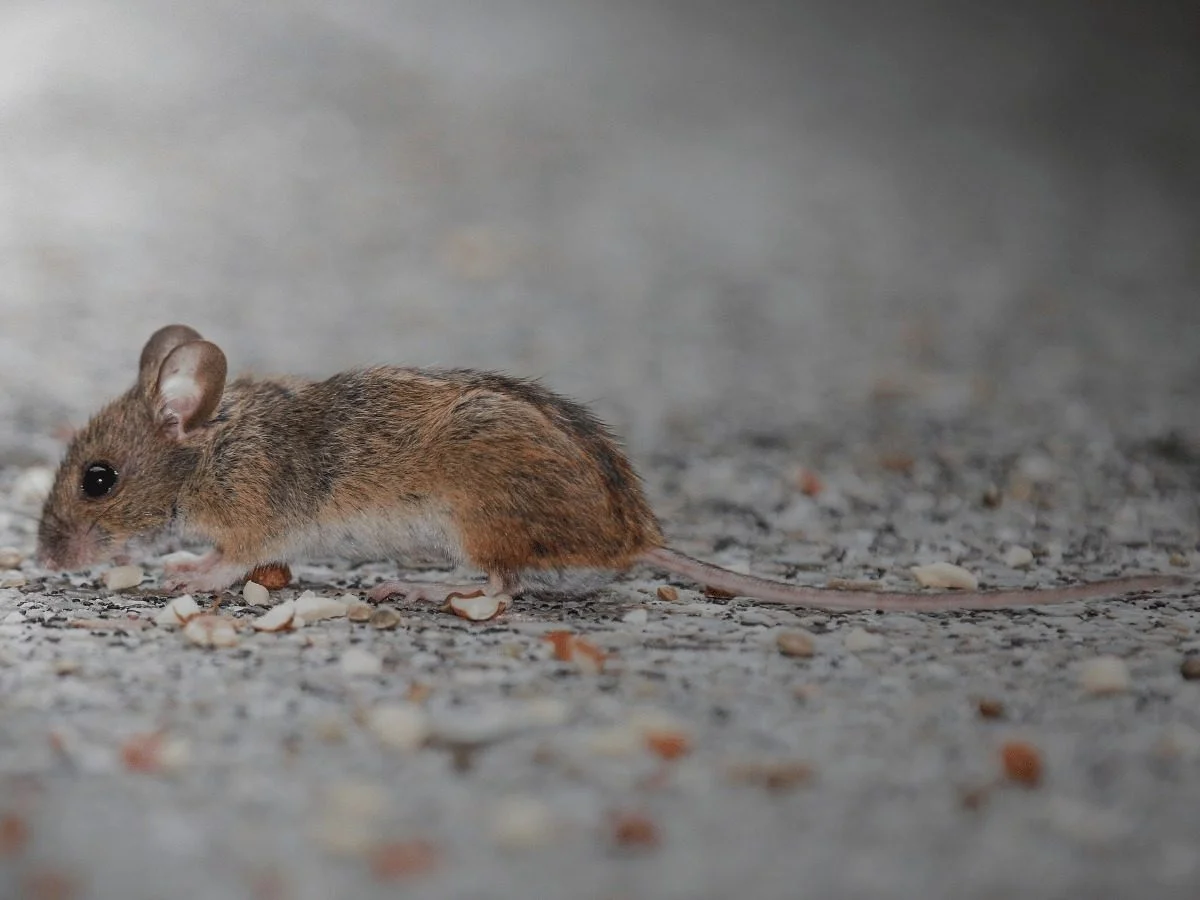
How to identify a house mouse
| Feature | House mouse |
|---|---|
| Body length | 2.5–4 in (plus tail) |
| Tail | About as long as the body, thin, lightly furred |
| Fur | Uniform dusty gray-brown above, only slightly paler below |
| Belly | Gray, not clean white — the key mark |
| Ears | Large for the head |
| Muzzle | Pointed |
| Droppings | ⅛–¼ in, rice-sized, pointed ends |
| Gap needed to enter | About ¼ inch (a dime) |
House mouse vs. deer mouse — this one matters
The house mouse's most useful ID mark is what it is not. A deer mouse is sharply bicolored — brown above with a clean white belly, white feet, and a distinctly two-toned tail — and it is the primary hantavirus carrier in the United States.
A house mouse is uniformly gray-brown with a gray belly, no sharp two-tone line.
Why it matters: if you have a bicolored, white-bellied mouse — most likely on a rural property, in West Odessa, or in a shed or outbuilding — the cleanup protocol changes and dry-sweeping is off the table. When in doubt, treat it as the more cautious case. See hantavirus & deer mice.
Why one mouse becomes many, fast
This is the single most important thing to understand about a house mouse, because it is why "we only saw one" turns into a real problem:
- A female can breed at around 5–6 weeks old
- Gestation is roughly three weeks
- Litters run about 5–6 young, multiple times a year
Do that math across a West Texas fall and the "one mouse" you saw in October is a working population by the new year. A house mouse problem is a clock. The sooner you deal with it, the smaller the job.
House mouse behavior
Curious, not cautious. Unlike a neophobic rat, a mouse investigates new objects readily — which is exactly why mouse trapping works faster than rat trapping when it is done right.
Small home range. A house mouse typically stays within a small radius of its nest — often just 10–30 feet — and nests close to food. This is why trap placement matters so much: a trap ten feet from the runway might as well be in another building. It also means droppings and activity cluster, which helps locate the nest.
Nibbles many things. Rather than eating a full meal in one place, a mouse takes small amounts from many spots, leaving scattered droppings and gnaw marks near the food source instead of dragging food to a cache the way a rat does.
Where they nest. Wall voids, cabinet and drawer backs, behind and under appliances, in pantry clutter, in stored boxes and paper, in insulation, and in the backs of garages and closets — anywhere enclosed, dark, and near food.
When they are active. Mostly at night, but a heavier infestation produces daytime sightings.
They only need ¼ inch. A house mouse fits through a gap the width of a dime, and it can flatten and work a gap smaller than seems possible. This is why mouse exclusion has to be meticulous — the openings are small enough that people walk past them for years.
The signs of house mice
- Rice-sized droppings — ⅛–¼ inch, pointed — in drawers, cabinets, the pantry, under the sink, and along baseboards. The most common first sign.
- A light, fast skittering inside a wall or above a cabinet — quicker and lighter than a rat's deliberate thump.
- Gnaw marks and small holes on food packaging, boxes, and baseboards.
- A musky ammonia odor in an enclosed space like a pantry or cabinet.
- Grease and rub marks along baseboards and around openings they use.
- Nests of shredded paper, fabric, insulation, and packaging in a drawer, a cabinet back, or behind an appliance.
- Disturbed or nibbled food — small nibble marks near the source, not a cache.
- A pet fixated on a cabinet, an appliance, or the base of a wall.
Why the DIY mouse-trap run usually stalls
People buy traps, catch two or three mice, and think it is over. Then it comes back. Here is why:
- The traps were in the wrong place. A mouse runs edges and walls, not the open middle of a room. Traps set out in the open, away from the runway, get ignored.
- There were not enough of them. A real mouse population needs traps in volume, set in pairs along active runways — not two traps for the whole house.
- The entry point was never sealed. Trapping removes the mice that are inside. It does nothing about the ¼-inch gap letting the next ones in. This is the step DIY almost always skips, and it is the reason the problem returns.
- The breeding outran the trapping. Catch mice slowly while the population reproduces on the schedule above, and you never get ahead of it.
The fix is the same order every time: trap them out, then seal the ¼-inch gaps so the next generation cannot follow. See mouse control service and rodent exclusion & proofing.
Why Odessa homes get house mice
- Cold fronts. A hard Permian Basin front sends mice indoors within hours looking for warmth.
- Summer heat and drought push them toward the cool, humid microclimate inside — kitchens, laundry rooms, and the shaded side of the slab.
- Caliche soil movement opens the small gaps at slab edges, thresholds, and utility penetrations that a ¼-inch animal needs.
- Garage and pantry food — pet food, bird seed, and stored dry goods are the anchor a mouse nests next to.
Seasonal timing: Odessa Rodent Seasonal Calendar »
Frequently asked questions
What does a house mouse look like?
A house mouse (Mus musculus) is a small rodent, about 2.5 to 4 inches of body plus a thin tail roughly as long, with uniform dusty gray-brown fur, a gray (not white) belly, large ears, and a pointed muzzle. Its droppings are rice-sized — about an eighth to a quarter inch — with pointed ends.
How do I tell a house mouse from a deer mouse?
Look at the belly and tail. A house mouse is uniformly gray-brown with a gray belly; a deer mouse is sharply bicolored — brown above with a clean white belly, white feet, and a two-toned tail. The distinction matters because deer mice are the primary hantavirus carrier, so a bicolored white-bellied mouse calls for extra caution and no dry-sweeping.
How many mice is "one mouse" really?
Usually more than one. House mice breed quickly — females can reproduce at around five to six weeks old, gestation is about three weeks, and litters run roughly five to six young multiple times a year — so a single mouse in fall commonly becomes an established population by winter. Seeing one is a reason to act early, while the job is small.
How small a gap can a house mouse get through?
About a quarter inch — roughly the width of a dime. Mice can flatten their bodies and work through gaps that look far too small, which is why mouse exclusion has to be meticulous around slab edges, thresholds, garage door corners, weep holes, and utility penetrations.
Why do I keep catching mice but they keep coming back?
Because trapping removes the mice inside but does nothing about the gap letting new ones in. Without sealing the quarter-inch entry points, and with the population breeding on its own schedule, you catch mice indefinitely. The lasting fix is to trap them out and then exclude — seal the openings — so the next generation cannot get in.
Where do house mice nest in a home?
In enclosed, dark spaces close to food: wall voids, the backs of cabinets and drawers, behind and under appliances, in pantry and garage clutter, in stored boxes and paper, and in insulation. Because a mouse keeps a small home range and nests near its food, droppings and activity usually cluster near the nest.
Are house mice dangerous?
House mice contaminate food and surfaces with droppings and urine, can carry disease organisms including salmonella, gnaw wiring and packaging, and their presence can aggravate allergies and asthma. They are less associated with hantavirus than deer mice, but any rodent droppings should be cleaned wetted and with protection, never dry-swept. See rodent droppings cleanup
Do mice come inside in the winter in Odessa?
Yes. Cold fronts are one of the biggest drivers of indoor mouse activity in the Permian Basin — a hard front pushes mice indoors within hours seeking warmth. Fall is the time to seal entry points, before the first cold snap turns an outdoor population into an indoor one.
Main pages Rodent control in Odessa, TX·Odessa rodent identification·How we seal a building