
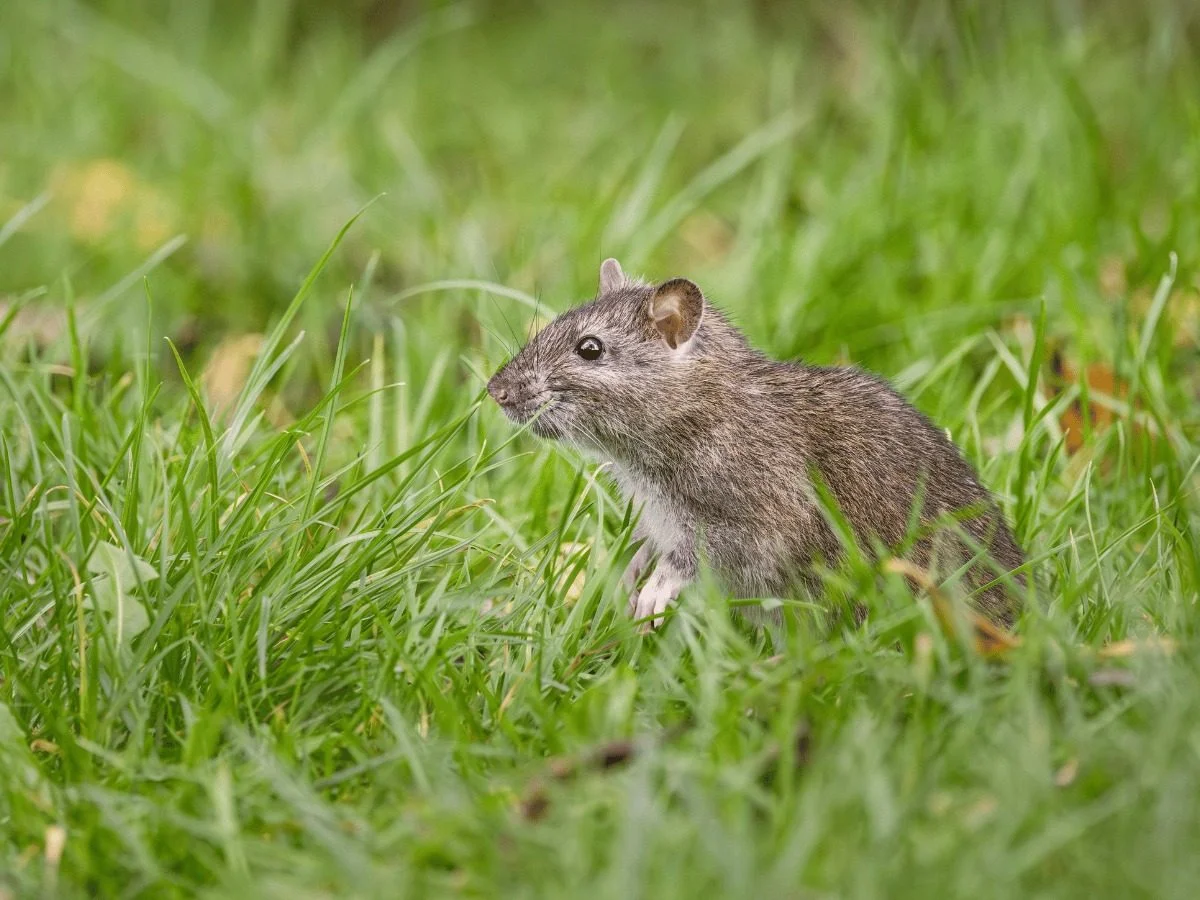
How to identify a cotton rat
| Feature | Cotton rat |
|---|---|
| Body length | ~5–8 in (plus tail) |
| Tail | Shorter than the body, sparsely haired |
| Fur | Coarse and grizzled — mixed brown, black, and gray, giving a peppered look |
| Texture | Bristly ("hispid" means bristly) |
| Ears | Small, largely hidden in the fur |
| Eyes | Small |
| Build | Stocky, thick, robust |
| Where found | Outdoors in grass and weeds |
Cotton rat vs. Norway rat — the two get mixed up
Both are stocky with short tails, so people confuse them. The separators:
| Cotton rat | Norway rat | |
|---|---|---|
| Fur | Coarse, grizzled, peppered look | Smoother, more uniform brown-gray |
| Ears | Small, buried in fur | Small but visible |
| Primary habitat | Grass, weeds, field edges | Foundations, burrows, buildings, sewers |
| Sign | Surface runways through vegetation | Burrow holes 2–4 in across |
| Indoor tendency | Occasional, driven by lost cover | Establishes and stays |
The single best field sign: a cotton rat cuts surface runways — visible trails worn through grass and weeds, like tiny paths. A Norway rat digs burrows. Runways in the grass mean cotton rat; smooth holes at the foundation mean Norway rat.
Cotton rat behavior
They live in vegetation, at ground level. Tall grass, weedy lots, ditches and drainage areas, field and pasture edges, fence lines with heavy growth, and irrigated or landscaped areas that stay green.
They build runways, not burrows. Networks of worn surface trails through the grass connecting feeding and nesting areas, with nests of shredded grass built at or just below ground level, under debris, or in dense cover.
They are mostly plant eaters — grasses, seeds, stems, and shoots — and they will work a garden, landscaping, and irrigated turf.
They are active day and night, unlike the strictly nocturnal commensal rats, so a daytime sighting in tall grass is normal for this species.
Their populations swing hard. Cotton rat numbers rise and crash dramatically with rainfall and vegetation. A wet season with heavy growth can build a large local population — which is exactly what makes the next mowing or freeze a problem for adjacent buildings.
The Odessa pattern: what actually triggers a cotton rat problem
Cotton rats do not usually decide to move into your house. Something removes their cover, and they relocate to the nearest shelter. The common triggers around Odessa and Ector County:
- A vacant lot or field gets mowed — the most common trigger of all
- Land is cleared for construction or a new development breaks ground
- A hard freeze or drought flattens the vegetation they were living in
- A ditch, drainage area, or right-of-way is cleaned out
- Irrigation stops on a green area that was supporting them
When that happens, they move into whatever is adjacent: sheds, garages, outbuildings, barns, foundations, stored equipment, and the edges of homes — especially on properties backing up to open land in West Odessa, at the city fringe, and around oilfield sites.
This is why timing matters. If you know the field next to you is about to be cleared, sealing your structures beforehand is dramatically cheaper than dealing with what arrives afterward.
What cotton rats do
- Garden and landscape damage — they eat stems, shoots, seeds, and turf, and can work through a vegetable garden
- Damage to stored goods in sheds, barns, and garages once they get in
- Gnawing and nesting in outbuildings and stored equipment
- Irrigation and drip-line damage
- Disease considerations. Like other wild rodents, cotton rats can carry zoonotic organisms, and their nests can harbor other pests. In the United States, hantaviruses are associated with several rodent species, with the deer mouse being the primary carrier — but the practical rule is the same for any wild rodent: droppings and nesting get wetted and cleaned with protection, never dry-swept. See droppings cleanup and rodent diseases & health risks.
How we handle cotton rats
Because this is fundamentally an outdoor-pressure problem, the work is weighted toward the perimeter and the property, not the interior.
- Free inspection. We confirm cotton rat versus Norway rat from the sign — runways versus burrows — locate the source vegetation and the runway network, and map every entry point on the structures under pressure. Detail: rodent inspection
- Exclusion on the structures at the field edge. Sheds, garages, outbuildings, barns, and the home itself sealed at grade with galvanized steel mesh and rigid material — thresholds, garage door corners, foundation gaps, weep holes, and utility penetrations. Core service: rodent exclusion & proofing
- Trapping of the animals that have already moved into structures.
- Habitat and buffer work. Reducing tall grass, weeds, and debris immediately against buildings creates a cleared buffer that cotton rats will not readily cross into. This is one of the highest-value steps for this species specifically.
- Decontamination of nesting and droppings in structures — wetted, never dry-swept.
- Follow-up verification. We come back and confirm zero activity, and re-check the sealed points.
A note on what we can and cannot control: if the source is a neighboring vacant lot or open range, we cannot manage vegetation on land you do not own. What we can do is seal your structures and create a buffer on your side of the line — which is what actually keeps them out of your buildings.
Frequently asked questions
What is a cotton rat?
A hispid cotton rat (Sigmodon hispidus) is a native grassland rodent with coarse, grizzled brown-black fur, small ears largely hidden in that fur, a stocky build, and a tail shorter than its body. It lives outdoors in grass and weeds, cutting visible surface runways through vegetation, and pushes into nearby structures when its cover is removed.
How do I tell a cotton rat from a Norway rat?
Look at the fur and the sign. A cotton rat has coarse, grizzled, peppered fur with ears buried in it, and leaves surface runways worn through grass; a Norway rat has smoother fur and digs burrow holes about two to four inches across near foundations. Runways in vegetation mean cotton rat; burrows at the foundation mean Norway rat.
Why did rats suddenly appear after the field next door was mowed?
Because mowing removed the cover a resident cotton rat population was living in, and the animals relocated to the nearest available shelter — commonly the adjacent shed, garage, outbuilding, or foundation. This is the single most common trigger for a cotton rat problem in Odessa, and it is also why sealing structures before a nearby lot gets cleared is far cheaper than dealing with the aftermath.
Do cotton rats live inside houses?
Not typically. Cotton rats are outdoor grassland animals that nest in vegetation at ground level, and they enter structures opportunistically when their cover is lost. They are much more likely to end up in a shed, garage, barn, or outbuilding than established in the walls of a home the way a house mouse or Norway rat would be.
Are cotton rats active during the day?
Yes. Unlike roof rats and Norway rats, which are largely nocturnal, cotton rats are active both day and night, so seeing one moving through tall grass in daylight is normal for the species rather than a sign of a heavy infestation.
What damage do cotton rats cause?
Mostly outdoor damage — eating garden plants, turf, stems, seeds, and shoots, and chewing irrigation and drip lines. Once they get into a shed, garage, or barn they gnaw and nest in stored goods and equipment. Like any wild rodent they can carry zoonotic organisms, so droppings and nesting should be cleaned wetted and with protection, never dry-swept.
How do I keep cotton rats out of my shed and garage?
Seal the structure at ground level — thresholds, garage door corners and bottom seal, foundation gaps, weep holes, and utility penetrations — with galvanized steel mesh and rigid, chew-proof material, and clear tall grass, weeds, and debris immediately against the building to create a buffer they will not readily cross. Trapping handles whatever is already inside.
The grass causing the problem is on a lot I don't own. What can I do?
You cannot manage vegetation on someone else's property, but you can make your side of the line unattractive and your buildings impenetrable. Clearing a buffer on your own property and sealing every structure at grade is what actually keeps them out, regardless of what the neighboring lot looks like.
Main pages Rodent control in Odessa, TX·Odessa rodent identification·How we seal a building