
Not sure what you've got? Text a photo to (432) 319-8327 — we'll identify it, usually the same day.
Call (432) 319-8327Start here: the fastest reliable ID
You will almost never get a clear look at the animal. You will get droppings. So start there.
| House mouse | Roof rat | Norway rat | |
|---|---|---|---|
| Dropping size | ⅛–¼ in (rice) | ~½ in | ~¾ in |
| Dropping ends | Pointed | Pointed, spindle-shaped | Blunt, capsule-shaped |
| Where found | Scattered, in enclosed spaces | On beams, in attics, up high | Along walls, low, near burrows |
| Body length | 2.5–4 in | 6–8 in | 7–10 in |
| Tail vs. body | About equal | Longer than body | Shorter than body |
| Muzzle | Pointed | Pointed | Blunt |
| Ears / eyes | Large for its head | Large, prominent | Small |
| Build | Tiny, slight | Slender, athletic | Heavy, thick |
| Enters | Anywhere ≥ ¼ in | High — roofline, vents | Low — foundation, garage |
| Temperament | Curious | Cautious, agile climber | Cautious, powerful digger |
The two rules worth memorizing:
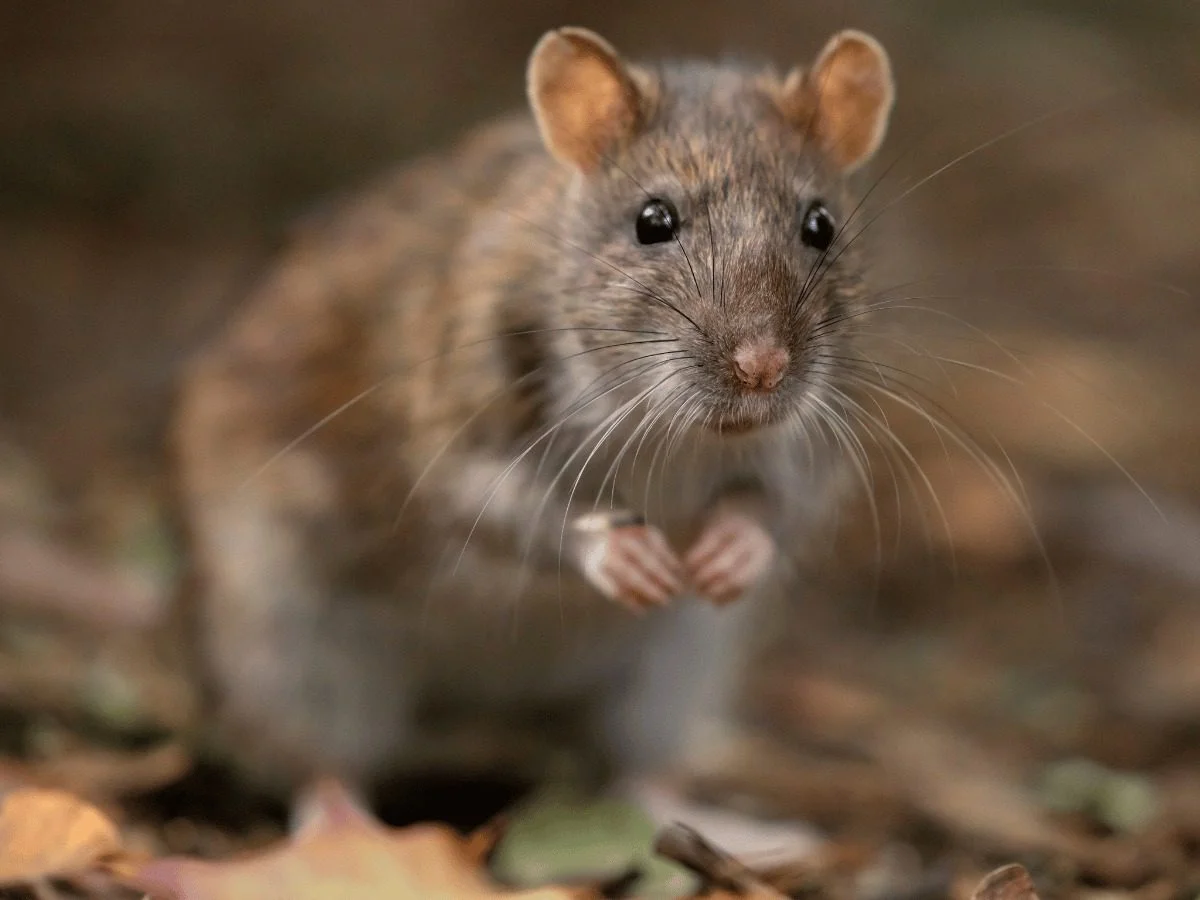
- Tail longer than body = roof rat. Tail shorter than body = Norway rat. This is the most reliable single field mark on a rat, and it tells you whether to work the roof or the foundation.
- A furred tail means it is not a rat at all — it is a woodrat (pack rat), a native species with a completely different treatment approach. Rats in the genus Rattus have naked, scaly tails.
Deeper comparison: Rat vs. Mouse Droppings »
The commensal species — the ones that live with you
These are the non-native rodents that infest buildings. If something is in your walls, kitchen, or attic, it is almost certainly one of these three.
🐁 House mouse — the most common indoor rodent in Odessa
Small, uniformly dusty gray-brown, 2.5–4 inches of body with a tail about as long. Rice-sized pointed droppings scattered in drawers, cabinets, and pantries. Curious rather than cautious, which makes it easier to trap than a rat — but it breeds fast enough that a fall sighting becomes a winter population.
Gets through a gap about ¼ inch — the width of a dime.
Full house mouse guide » · Mouse control service »
🐀 Roof rat — the climber, and the attic problem
Slender and athletic, pointed muzzle, large ears, large prominent eyes, and a tail longer than its body. Travels fence lines, tree limbs, block walls, and utility lines, then enters high — roofline gaps, fascia separation, gable and attic vents, and the AC line-set penetration.
If the noise is above your ceiling, start here. Ground-level bait stations never touch a roof rat population.
Full roof rat guide » · Rat control service »
🐀 Norway rat — the burrower, and the foundation problem
Heavier and thicker than a roof rat, blunt muzzle, small ears and eyes, and a tail shorter than its body. Digs burrows — smooth holes roughly 2–4 inches across — along foundations, under slabs, patios, sheds, and woodpiles, and works drain and sewer lines.
If you are seeing burrow holes near the foundation, or activity in the garage and lower walls, start here.
Full Norway rat guide » · Rat control service »
The native West Texas species — the ones the chains ignore
This is where Odessa stops looking like the rest of the country. These are native animals living in the mesquite, caliche, and open range around town, and they press against your buildings continuously rather than arriving as a one-time infestation.
🌵 Pack rat (woodrat) — the wiring wrecker
The single most under-treated rodent in the Permian Basin. Both the white-throated woodrat (Neotoma albigula) and the southern plains woodrat (Neotoma micropus) occur in this region, and locally both get called pack rats.
The diagnostic: a furred, bicolored tail — not the naked scaly tail of a true rat — plus large ears, large eyes, and a pale throat and chest.
They build bulky nests of sticks, cactus pads, and debris called middens, hoard objects, and chew vehicle and AC wiring for nesting material. If something is nesting in your engine bay or your AC condenser, this is almost certainly the animal.
Full pack rat guide » · Vehicle wiring damage » · AC unit rodent control »
🦌 Deer mouse — the one that changes the cleanup protocol
Distinctly bicolored: brown or grayish above, a clean white belly, white feet, and a sharply two-toned tail. Larger eyes and ears than a house mouse.
Deer mice are the primary hantavirus carrier in the United States. They are far more common on Odessa's rural edges, in West Odessa, and in sheds, barns, and outbuildings than in the middle of a subdivision. Their droppings and nesting material must never be dry-swept or dry-vacuumed.
Full deer mouse guide » · Hantavirus & deer mice »
🌾 Cotton rat — the field-edge invader
Stocky, with coarse grizzled brown-black fur, small ears largely buried in that fur, and a tail shorter than its body. Lives in grass and weeds, cutting distinct surface runways through vegetation, and pushes into structures at the field edge — especially when a grassy lot gets mowed or a field is cleared.
Not a rat or mouse at all
Holes in the yard, mounds in the lawn, something running along a block wall in daylight — these are usually ground squirrels or pocket gophers, and they are a completely different animal with a completely different approach. Daylight activity outdoors is the giveaway; rats and mice are mostly nocturnal.
Ground squirrels, prairie dogs & pocket gophers »
Identify by what you're experiencing
Sometimes you have a symptom, not a specimen.
| What you're noticing | Most likely |
|---|---|
| Heavy thumping and dragging overhead at night | Roof rat |
| Light, fast skittering in a wall | House mouse |
| Rice-sized droppings in a kitchen drawer | House mouse |
| Raisin-sized droppings along a garage wall | Norway rat |
| Smooth 2–4 in holes near the foundation | Norway rat |
| Sticks and cactus piled in your engine bay | Pack rat |
| Chewed wiring in a vehicle or AC unit | Pack rat |
| Bicolored mouse with a white belly, in a shed | Deer mouse |
| Runways worn through tall grass at a field edge | Cotton rat |
| Fan-shaped soil mounds with no open hole | Pocket gopher |
| Open holes in the yard, animal active in daylight | Ground squirrel |
| A smell with no visible source | Any — dead rodent in a wall |
More symptom help: Scratching in walls · Rats in the attic · Rats in the garage · Rodent smell in the house
Why Odessa gets this particular mix
Most cities deal with two or three commensal species. We deal with those plus a native desert-grassland community pressing in from every direction:
- Open range at the city edge. West Odessa, Gardendale, and the Ector County fringe sit against mesquite, cactus, and grassland where woodrats, deer mice, and cotton rats live year-round.
- Extreme summer heat. Weeks over 100°F drive every species toward shade, moisture, and cool air — which means your AC chase, your garage, and the shaded side of your slab.
- Hard cold snaps. A Permian Basin front sends rats and mice indoors within hours.
- Caliche soil movement. Shifting, settling caliche cracks slabs and separates additions, opening entry points that did not exist when the house was built.
- Oilfield structures everywhere. Metal buildings, shops, sheds, and remote facilities extend rodent habitat across the whole basin. See oilfield facility rodent control.
Seasonal timing: Odessa Rodent Seasonal Calendar »
Related Rodent inspection·Rat control·Mouse control·Health risks·Our full FAQ
Frequently asked questions
What kind of rodents live in Odessa, Texas?
Odessa has three commensal (building-infesting) species — the house mouse, roof rat, and Norway rat — plus several native West Texas rodents: the pack rat or woodrat, the deer mouse, and the cotton rat. Ground squirrels and pocket gophers also occur but are outdoor animals rather than indoor pests.
How do I tell a rat from a mouse?
Size and droppings are the fastest indicators. A mouse is 2.5–4 inches of body with rice-sized pointed droppings scattered in enclosed spaces; a rat is 7–10 inches with raisin-sized droppings along travel routes. Mice are curious and stay near a food source, while rats are cautious and range farther.
How do I tell a roof rat from a Norway rat?
Compare the tail to the body. A roof rat's tail is longer than its body and it has a pointed muzzle with large ears and prominent eyes; a Norway rat's tail is shorter than its body and it has a blunt muzzle with small ears and eyes. This matters because roof rats enter high at the roofline and Norway rats enter low at the foundation.
What is the difference between a pack rat and a regular rat?
The tail. A pack rat, or woodrat, has a furred, bicolored tail, while true rats have naked scaly tails. Pack rats are native West Texas animals with large ears, large eyes, and a pale throat, and they build bulky stick-and-debris nests called middens — often in engine bays and AC condenser units, where they chew wiring.
Which Odessa rodent carries hantavirus?
The deer mouse is the primary hantavirus carrier in the United States, and it is present on Odessa's rural edges and in outbuildings. Several native bicolored mice in West Texas look similar and can be difficult to distinguish, so the safe practice is to treat any bicolored, white-bellied native mouse with the same precaution: never dry-sweep or dry-vacuum its droppings.
Can you identify a rodent from a photo?
Usually, yes. A clear photo of droppings is often enough to determine rat versus mouse, and a photo of the animal or its nest can identify the species. Text (432) 319-8327 and we will tell you what you are dealing with, typically the same day.
Does it really matter which species I have?
Yes — it determines where treatment happens. Roof rats require work at the roofline, attic vents, and eaves; Norway rats require work at the foundation, garage, and drain lines; pack rats require habitat and vehicle work; and deer mice change the cleanup protocol because of hantavirus. Treating the wrong species correctly still fails.
What if I have more than one species?
It happens, particularly on properties at the edge of town where a house mouse population indoors coexists with woodrats and deer mice in the outbuildings and vehicles. A proper inspection identifies each one and addresses them separately rather than applying one approach everywhere.
Main pages Rodent control in Odessa, TX·How we seal a building