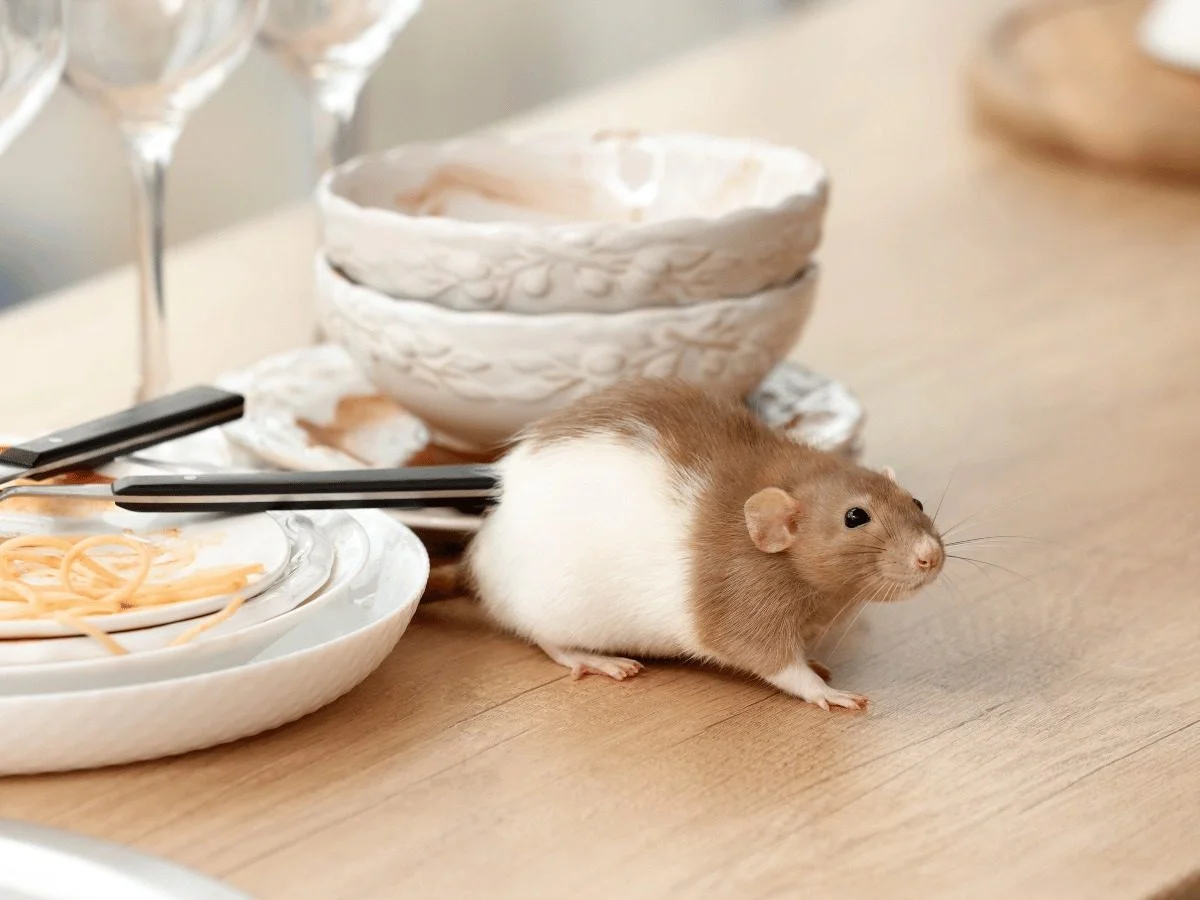
Why restaurants are the hardest rodent environment there is
Nothing about a working kitchen helps you.
Food and water are permanent and unlimited. Every rodent attractant that a homeowner is told to eliminate is your inventory. You cannot remove the food source — that is the business.
The building has to stay open. Back doors during a rush. A receiving door propped for a delivery. A dock or alley door left open for airflow in an Odessa August. Every one of those is an entry point that no amount of hardware can seal, because it exists to let people and product through.
Heat and grease. Cooking heat, dish machines, and warm equipment make the space attractive year-round, and grease residue behind and beneath equipment is a food source in places nobody cleans daily.
Harborage everywhere. Hollow equipment bases, the void behind the walk-in, suspended ceilings, dry storage shelving, mop sink corners, cardboard cases, and the space between the wall and every piece of stationary equipment.
Waste concentration outside. A dumpster or grease bin is the single strongest rodent attractant on your property, and it is usually within thirty feet of your back door.
Shared buildings. In a strip center, a food court, or a downtown block, your neighbors' rodents are your rodents. They travel shared wall voids, common attics, and utility chases without noticing your lease line.
None of this means it cannot be controlled. It means restaurant rodent control is a discipline — a combination of hard exclusion, aggressive sanitation targeting, and documented monitoring — rather than a bait box in the back hall.
What is at stake
- Health inspection findings. Rodent activity — droppings, gnaw marks, live or dead rodents — is treated as a serious violation, and depending on severity and jurisdiction it can lead to enforcement action up to closure. Texas food establishments are inspected under the Texas Food Establishment Rules by whichever authority permits your location, and the resulting report is a record you do not control.
- Reputation. A single sighting posted publicly follows the business long after the problem is fixed. This is usually the largest real cost.
- Product loss. Contaminated dry goods and packaging have to be discarded.
- Contamination of food-contact surfaces. Rodent droppings and urine can carry disease organisms, and rodents travel across prep surfaces and storage at night.
- Equipment and structural damage. Chewed wiring in equipment and walk-in units, damaged insulation, gnawed packaging and containers.
- Staff morale. Kitchens talk. A rodent problem that management appears to be tolerating is a retention issue.
How we work a food service account
- Free assessment, scheduled around service. Full survey of the kitchen, prep, dry storage, walk-in and cooler areas, bar, dining room, restrooms, mop and utility areas, suspended ceilings, receiving and dock area, dumpster and grease bin area, roof and roofline, and the full exterior perimeter. Species identified, harborage located, and every entry point mapped. Detail: rodent inspection.
- Exclusion — the part that actually reduces your risk. This is where most restaurant pest contracts quietly do nothing, because a sealed building needs less service and service is the vendor's revenue. We seal:
- Door sweeps and thresholds on every exterior door, including the ones nobody looks at
- Dock and receiving door seals and roll-up door edges
- Utility, conduit, plumbing, and gas line penetrations
- Gaps behind and beneath fixed equipment, and hollow equipment bases
- Wall and floor penetrations into the walk-in and cooler areas
- Roofline, vent, and roof penetration screening
- Drain and sewer routes where rats are using them
- Shared-wall penetrations into neighboring units, where accessible
Core service: rodent exclusion & proofing
- Removal of the active population. Trapping, set in the runways the activity is actually using — out of all customer sightlines and out of food-handling zones. In a kitchen, where the animal ends up matters as much as whether it is removed: an animal that dies inside a wall or above a suspended ceiling becomes a decomposition and contamination problem in a food environment, which is why the work is built around taking them out of the building and closing the routes they came in through.
- Sanitation targeting. We tell you exactly where the harborage and food residue is that we cannot fix for you — behind that specific piece of equipment, under that shelf, in that corner of dry storage. A specific, actionable list beats a generic "improve sanitation" note that everyone ignores.
- Contamination cleanup and disinfection. Droppings and nesting removed and surfaces disinfected — handled wetted, never dry-swept, especially in a food environment. See droppings cleanup.
- Exterior and waste area work. Dumpster and grease bin area, drain lines, landscaping and harborage against the building, and any burrows along the foundation.
- Documented monitoring. This is one of the cases where recurring service is genuinely needed rather than upsold — because your entry points cannot all be permanently sealed and because an inspector wants to see an active, documented program. What frequency actually fits your operation is something we settle at the assessment, and the exclusion work is what reduces how much of it you need.
- Records you can show an inspector. Tell us what your inspector, your landlord or your corporate office asks to see, and we will confirm exactly what we can provide and in what form before the first visit — while it can still be built into how the work is run, rather than reconstructed afterwards.
Service that does not touch your operation
- After-hours, overnight, and pre-opening service. We are Emergency service available 24/7, so food-service work gets scheduled around your operation — after close, overnight, or before you open.
- Nothing left where a guest or an inspector will find it wrong. Placement is part of the job, not an afterthought, and nothing goes in customer view.
- Priority when there has been a sighting or an inspection is coming. We are available 24/7; say that on the call and it is treated as the different thing it is.
- Licensed rodent control, and rodents are all we do — which is why the sealing work gets the attention it does here instead of being an add-on to a spray route.
Frequently asked questions
Do you provide rodent control for restaurants in Odessa?
Yes. We service restaurants, commercial kitchens, bars, bakeries, food trucks, convenience stores, and institutional kitchens throughout Odessa — with exclusion-led treatment, after-hours scheduling, and records prepared with a health inspection in mind.
Will a rodent problem fail my health inspection in Texas?
Evidence of rodent activity — droppings, gnaw marks, or live or dead rodents — is treated as a serious violation under the Texas Food Establishment Rules, and depending on severity it can lead to enforcement action up to closure. Inspectors also look for whether you have an active, documented pest control program, which is why the records matter as much as the condition on the day.
Can you service my restaurant after we close?
Yes. We are Emergency service available 24/7, so food service work is scheduled around your operation — after close, overnight, or before opening — and never during service or food handling. Tell us your quiet window when you call (432) 319-8327 and we will work to it.
We found droppings in dry storage. What do we do with the product?
Anything in packaging a rodent can breach — cardboard, paper sacks, bagged goods — has to be treated as contaminated and discarded rather than wiped down, and product in sealed rigid containers should be inspected before it goes back on the shelf. The cleanup itself is done wetted, never dry-swept, and the surfaces are disinfected afterwards. Then the actual fix is the shelving and the wall gap behind it, because dry storage keeps producing droppings for as long as the harborage is still there. See droppings cleanup.
What documentation will you give me for the health inspector?
Tell us what your inspector, your landlord or your corporate office asks to see, and we will confirm what we can provide and in what format before the first visit. Getting that agreed up front is worth far more than a generic report, because what an inspector or an auditor wants is evidence of a program that is real and active.
The rodents are coming from the restaurant next door. What can you do?
We can seal your unit and document the source, which is usually what a landlord or property manager needs before addressing the shared structure or the neighboring tenant. Rodents travel shared wall voids, common attics, and utility chases regardless of lease boundaries, so sealing your unit substantially reduces the problem while resolving the shared structure is what ends it.
How often does a restaurant need rodent service?
Food service is one of the cases where recurring monitoring is genuinely necessary rather than an upsell, because doors that must open for staff and deliveries cannot be permanently sealed and because inspectors expect an active documented program. What interval actually fits your operation depends on the building, the activity and what your inspector expects, so we settle it at the assessment — and the exclusion work is what reduces how much ongoing service you need.
We had a customer see a mouse. How fast can you get here?
Fast response with 24/7 availability. Call (432) 319-8327 and say it was a customer sighting — that is a different priority than routine service, and it is treated as one.
Do you handle food trucks and mobile units?
Yes. Mobile units have their own weak points — the underside, utility and plumbing penetrations, service door seals, and the generator and equipment compartments — plus the same wiring-chew exposure any parked vehicle has out here. See rodent vehicle wiring damage.
Is exclusion even possible when our back door is open all day?
You cannot seal a door that has to open, so exclusion in food service targets everything else — thresholds and sweeps on every other opening, dock seals, all utility and plumbing penetrations, equipment bases, walk-in penetrations, roofline and roof penetrations, and drain routes. Closing the permanent openings is what makes the unavoidable temporary ones manageable, and it is why a sealed restaurant needs far less ongoing service than an unsealed one.
Main pages Rodent control in Odessa, TX·Commercial rodent control·How we work·What it costs